More than 50 years after the last Apollo mission, NASA astronauts are once again on their way to the Moon as the Artemis II mission begins its historic journey into deep space. Following a crucial engine burn that pushed the Orion spacecraft beyond Earth’s orbit, the four-member crew is now traveling toward a planned lunar flyby marking a major step in humanity’s return to the Moon and future exploration missions to Mars.
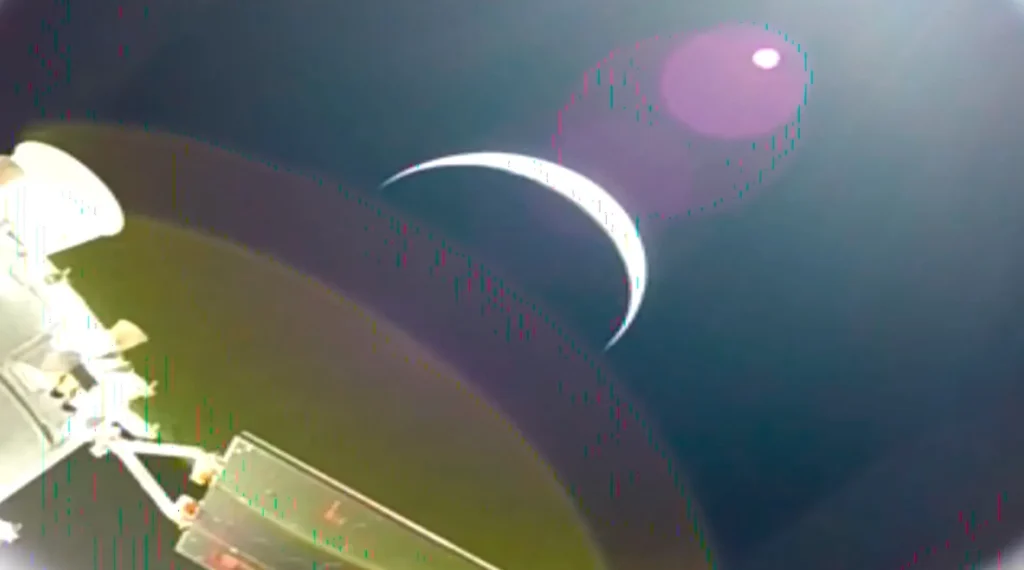
Credit: NASA
NASA — For the first time in more than half a century, astronauts aboard a NASA mission are once again heading toward the Moon, marking a historic return to deep space exploration. The milestone follows the successful ignition of Orion’s primary engine, a critical maneuver that propelled the spacecraft beyond Earth’s gravitational hold and set it on a path toward lunar orbit.
The engine firing, which lasted roughly six minutes and is known as the translunar injection burn, took place Thursday and provided the necessary boost for the Orion spacecraft to accelerate away from Earth’s orbit. On board are NASA astronauts Reid Wiseman, Victor Glover, and Christina Koch, along with Canadian Space Agency astronaut Jeremy Hansen. With the burn completed, the crew began their outbound journey toward the Moon, Earth’s closest celestial neighbor.
READ MORE ABOUT SPACE:
- NASA’s Artemis II Departs Earth Orbit for Historic Moon Flyby
- NASA: The Artemis Generation Takes Flight with Historic Artemis II Mission
The maneuver represents a defining moment for NASA’s Artemis II mission, as it marks the first time the Orion spacecraft has carried astronauts in space while operating beyond Earth’s orbit. The mission also signals humanity’s return to deep-space travel not seen since the Apollo 17 mission in 1972, the last time astronauts ventured beyond low-Earth orbit toward the Moon.
Dr. Lori Glaze, acting associate administrator for NASA’s Exploration Systems Development Mission Directorate at the agency’s headquarters in Washington, described the moment as a historic step forward for the Artemis program. She noted that the crew is now traveling on a carefully calculated trajectory toward the Moon, while engineers and mission teams gather valuable operational data from Orion’s first crewed journey through deep space. According to Glaze, each milestone achieved during the mission represents meaningful progress toward future lunar exploration and long-term human presence beyond Earth.
Although the successful burn marks a major accomplishment, the mission is far from over. The Artemis II crew still faces eight days of intensive mission operations, including system checks, navigation exercises, and preparations for their lunar flyby before returning safely to Earth. NASA officials say these activities will provide critical insights into spacecraft performance, crew operations, and navigation in deep space knowledge that will help shape future Artemis missions, including the eventual return of astronauts to the lunar surface.
The journey began earlier this week when NASA’s Space Launch System (SLS) rocket carried the Orion spacecraft and its four-member crew into space. The launch took place from Launch Pad 39B at Kennedy Space Center in Florida at 6:35 p.m. EDT on April 1, sending the astronauts on a 10-day test flight designed to circle the Moon and return to Earth. The mission is intended to validate the systems and procedures that will pave the way for upcoming Artemis missions aimed at establishing a sustained human presence on the Moon and preparing for future exploration of Mars. 🚀
After successfully reaching space, the Orion spacecraft extended its four solar array wings, allowing it to draw power directly from the Sun. With the vehicle now operating independently in orbit, astronauts aboard the capsule, along with mission controllers on the ground, immediately began the crucial transition from launch phase to full flight operations. This phase involved activating and evaluating the spacecraft’s core systems to ensure everything was functioning as expected.
Roughly 49 minutes after liftoff, the Space Launch System (SLS) rocket’s upper stage ignited its engine, sending Orion into an elliptical orbit around Earth. Soon after, the stage carried out a second planned burn, propelling the spacecraft—nicknamed “Integrity” by its crew—into a much higher orbit. This trajectory extended approximately 46,000 miles above Earth, where the spacecraft would remain for nearly a full day while engineers and astronauts conducted extensive system checks and performance evaluations. Following this maneuver, Orion separated from the rocket stage, continuing its journey independently through space.
As part of the mission’s test objectives, the crew later carried out a manual piloting demonstration designed to assess Orion’s maneuverability and handling in the space environment. During this exercise, the spacecraft used the Interim Cryogenic Propulsion Stage (ICPS) as a reference target, allowing astronauts to simulate docking-style maneuvers and refine their control of the capsule.
Once the demonstration was complete, Orion initiated an automated departure burn to safely move away from the ICPS. The upper stage then performed its own final disposal maneuver, steering itself toward Earth’s atmosphere. It ultimately re-entered over a remote section of the Pacific Ocean, ensuring no risk to populated areas.
Before the stage’s fiery descent, four miniature satellites known as CubeSats were deployed from the Orion stage adapter. These small research spacecraft were released into space to carry out their own independent missions, contributing additional scientific and technological data as part of the broader Artemis II test flight.
Other mission milestones have already been achieved as the crew settles into the journey beyond Earth. The spacecraft has successfully switched its communications link to NASA’s Deep Space Network, ensuring a stable connection as it travels farther from the planet. Meanwhile, the astronauts have begun adapting to the microgravity environment, completing their first scheduled rest periods and carrying out the mission’s initial exercise session using the onboard flywheel system. Engineers also confirmed that the spacecraft’s toilet system has been restored to normal operation, while the crew completed preparations to configure the vehicle for the critical translunar injection burn that will place them on course for the Moon.
During a planned lunar flyby on Monday, April 6, the astronauts are expected to capture high-resolution images and share real-time observations of the Moon’s surface. Particular attention will be given to regions on the lunar far side—areas that have never been directly observed by humans. Although this part of the Moon will only be partially illuminated during the flyby, the lighting conditions are expected to create long shadows across the terrain. These shadows will accentuate the Moon’s rugged features, helping reveal ridges, slopes, crater rims, and other subtle details that are often difficult to distinguish when the surface is fully lit.
After completing the lunar flyby, the crew will begin their return journey to Earth. The mission is scheduled to conclude with a splashdown in the Pacific Ocean, off the coast of San Diego, where recovery teams will retrieve the spacecraft and its crew.
Artemis II is part of a broader era of renewed exploration and technological progress for NASA. Through the Artemis program, astronauts will undertake increasingly ambitious missions to study the Moon, unlock new scientific knowledge, and open opportunities for economic development in deep space. These missions are also designed to lay the groundwork for humanity’s next giant leap sending astronauts on the first crewed missions to Mars.
Commentary: Humanity Reaches for the Moon Again—But At What Cost?
NASA’s Artemis II mission, which will send astronauts around the Moon for the first time in more than half a century, marks a defining moment in modern space exploration. For many scientists, engineers, and governments around the world, the mission symbolizes the dawn of a new era—a revival of humanity’s ambition to venture deeper into space after decades largely confined to low-Earth orbit.
Countries with established space programs, including the European Union, Canada, Japan, and Australia, have largely welcomed the mission. These nations see Artemis not just as an American effort, but as an international collaboration that could advance science, technology, and economic opportunities in the emerging space economy. The Canadian Space Agency’s participation through astronaut Jeremy Hansen is often cited as an example of how the Artemis program is gradually becoming a multinational effort.
Other major powers, however, view the renewed race to the Moon through a more strategic lens. China and Russia, which are pursuing their own lunar exploration initiatives, have emphasized the importance of independent space capabilities and have proposed an alternative lunar research station project. Analysts say the revival of lunar missions could trigger a new geopolitical competition in spacesometimes described as a “second space race.”
Beyond geopolitics, the mission has also sparked a deeper debate across many parts of the world: why prioritize space exploration when humanity continues to face urgent challenges on Earth? Critics argue that the billions of dollars invested in lunar missions could instead be directed toward solving pressing problems such as poverty, climate change, food insecurity, and global health crises. For communities struggling with basic needs, the idea of sending astronauts to the Moon can appear disconnected from the realities of life on Earth.
Supporters of space exploration counter that such missions are not merely symbolic adventures but investments in innovation. Historically, space programs have driven breakthroughs in communication technologies, satellite navigation, weather forecasting, medical imaging, and materials science. Proponents argue that research conducted through programs like Artemis could yield technologies that ultimately benefit life on Earth, including advancements in energy systems, robotics, and sustainable resource management.
Another positive effect often highlighted is the inspirational value of exploration. Major space missions have the power to unite people across borders and inspire younger generations to pursue careers in science, engineering, and technology. For many educators and policymakers, this long-term human capital development is one of the most valuable outcomes of ambitious space programs.
Still, critics warn that without careful global cooperation, lunar exploration could lead to disputes over resources and territory. The Moon is believed to contain valuable materials such as water ice and rare minerals that could support future space industries. As nations and private companies prepare to operate beyond Earth, questions about governance, ownership, and environmental protection of celestial bodies are becoming increasingly urgent.
Handling these concerns will require stronger international frameworks and transparent cooperation among spacefaring nations. Experts argue that space exploration should complement efforts to solve Earth’s problems rather than compete with them. Investments in science and technology can be balanced with policies that ensure the benefits of innovation are shared broadly and contribute to sustainable development on our home planet.
Ultimately, Artemis II represents both a technological triumph and a philosophical question for humanity. As astronauts once again journey toward the Moon, the world is reminded that exploration has always been part of human progress but so too is the responsibility to address the challenges faced here on Earth. The challenge for the coming decades will be ensuring that humanity’s reach for the stars goes hand in hand with efforts to improve life for all.
- Worst Country I’ve Visited- Thailand Girl, Stark Warning After Disappointing Vietnam Trip
- Artemis II | NASA, Voyage, Mission & Moon
- A Prayer of Thanksgiving for Divine Blessings, Triumph, Forgiveness, and Good Health
- NASA’s Artemis II Departs Earth Orbit for Historic Moon Flyby
- NASA: The Artemis Generation Takes Flight with Historic Artemis II Mission
- Victor Glover | Life, Education & NASA Career
- Philippines vs China, When Betrayal Comes from Within: The Cost of Selling a Nation
- Supreme Court Affirms Dismissal of GMA Network’s Complaint Against ABS-CBN Over TV Ratings Dispute
- List of political ideologies
- Andrew Heywood | British author, Educationalist, & political theorist
- Holy Wednesday: A Solemn Reminder on Judas Iscariot Betrayal of Jesus Christ
- Judas Iscariot | About in the Bible, Betrayal & Apostle
- Relief or Rhetoric? Imee Marcos’ Call to Suspend Government Deductions Remains Without Action—Just Words
- Gatchalian Renews Push to Keep Minors Off Social Media
- Donald Trump Floats Seizing Iran’s Kharg Island Oil Hub, Wider Middle East Conflict
https://www.nasa.gov/directorates/smd/nasa-science-live/https://www.nasa.gov/universe/what-are-black-holes/https://www.nasa.gov/centers-and-facilities/kennedy/kennedy-marks-remembrance-day/https://www.nasa.gov/history/americas-first-satellite-established-foothold-in-space/https://www.nasa.gov/centers-and-facilities/kennedy/first-time-event-sparks-wide-range-of-employee-innovation/https://www.nasa.gov/centers-and-facilities/kennedy/kennedy-space-center-honors-day-of-remembrance/https://www.nasa.gov/centers-and-facilities/kennedy/planting-seeds-of-innovation-event-inspires-engages-kennedy-employees/https://www.nasa.gov/history/sfa-message-everyone-plays-role-in-flight-safety-mission-success/https://www.nasa.gov/missions/analog-field-testing/human-related-altitude-chamber-complex/https://www.nasa.gov/missions/analog-field-testing/neemo/nasa-extreme-environment-mission-operations-neemo-studies/https://www.nasa.gov/centers-and-facilities/armstrong/jpl-masten-testing-spacecraft-precision-landing-software/https://www.nasa.gov/centers-and-facilities/kennedy/restoration-planned-for-shoreline-protecting-kennedy-infrastructure/https://www.nasa.gov/centers-and-facilities/kennedy/bald-eagles-rescued-after-storm-blows-through-space-center/https://www.nasa.gov/missions/space-shuttle/atlantis-unwrapped-as-preparations-continue-for-june-29-opening/https://www.nasa.gov/humans-in-space/commercial-space/nasa-craig-technologies-partnership-retains-crucial-capabilities/https://www.nasa.gov/centers-and-facilities/kennedy/ancient-creatures-on-the-prowl/https://www.nasa.gov/centers-and-facilities/kennedy/bambi-bucket-training-prepares-helicopter-crews-for-fighting-fires/https://www.nasa.gov/centers-and-facilities/kennedy/breaking-ground-for-a-new-beginning/https://www.nasa.gov/learning-resources/stem-engagement-at-nasa/brevard-county-space-week-inspires-future-explorers/https://www.nasa.gov/missions/station/cabana-announces-new-initiatives-for-multi-user-spaceport/https://www.nasa.gov/centers-and-facilities/kennedy/center-director-update-focuses-on-accomplishments-preparing-for-the-future/https://www.nasa.gov/centers-and-facilities/kennedy/citric-acid-tests-underway-on-stainless-steel-alloys-at-kennedy-space-center-facilities/https://www.nasa.gov/centers-and-facilities/kennedy/eagle-rescued-at-kennedy-now-stars-in-educational-program/https://www.nasa.gov/missions/tdrs/engineers-telemetry-fix-preserves-tdrs-l-launch
https://www.nasa.gov/missions/station/falcon-9-roars-skyward-to-send-dragon-on-supply-run-to-station/
https://www.nasa.gov/centers-and-facilities/kennedy/fish-spawned-at-spaceport-now-tracked-as-far-away-as-new-jersey/
https://www.nasa.gov/people-of-nasa/forrest-mccartney-hailed-for-his-kennedy-space-center-leadership/
https://www.nasa.gov/learning-resources/stem-engagement-at-nasa/goal-of-becoming-an-astronaut-brings-tanzanian-teen-to-the-space-coast/
https://www.nasa.gov/centers-and-facilities/kennedy/innovations-key-to-spaceport-transformation/
https://www.nasa.gov/centers-and-facilities/kennedy/jacobs-tosc-holds-town-hall-meetings-at-kennedy-space-center/
https://www.nasa.gov/centers-and-facilities/kennedy/keeping-the-dream-alive-honors-memory-of-dr-martin-luther-king-jr/
https://www.nasa.gov/centers-and-facilities/kennedy/kennedy-employees-celebrate-african-american-history-month/
https://www.nasa.gov/centers-and-facilities/kennedy/kennedy-hosts-expo-for-underutilized-businesses/
https://www.nasa.gov/missions/station/kennedy-preps-biological-research-for-flight-to-station/
https://www.nasa.gov/science-research/tech-research/kennedy-space-center-inventors-recognized-for-patented-technologies/
https://www.nasa.gov/centers-and-facilities/kennedy/kennedy-space-center-keeps-dark-skies-for-sea-turtle-nesting/
https://www.nasa.gov/humans-in-space/commercial-space/kennedys-transformation-shows-a-future-in-focus/
https://www.nasa.gov/learning-resources/stem-engagement-at-nasa/nasa-aids-tribal-school-in-becoming-four-year-university/
https://www.nasa.gov/centers-and-facilities/kennedy/nasa-fire-rescue-training-focuses-on-safe-helicopter-evacuations/
https://www.nasa.gov/centers-and-facilities/kennedy/nasa-kennedy-space-center-counts-down-to-santas-annual-toy-delivery-mission-2/
https://www.nasa.gov/people-of-nasa/nasa-mourns-loss-of-kennedy-test-director-norm-carlson/
https://www.nasa.gov/humans-in-space/commercial-space/nasa-partnerships-launch-multi-user-spaceport/
https://www.nasa.gov/science-research/nasas-e-mist-experiment-soars-in-earths-atmosphere/
https://www.nasa.gov/missions/station/plant-experiments-prepared-at-kennedy-for-spacex-crs-5-mission/
https://www.nasa.gov/centers-and-facilities/kennedy/power-of-the-human-spirit-theme-of-kennedy-space-centers-daawg-event/
https://www.nasa.gov/centers-and-facilities/kennedy/recycling-helps-reuse-valuable-resources-avoid-polluting-earth/
https://www.nasa.gov/centers-and-facilities/kennedy/restoration-of-protective-shoreline-completed-near-key-launch-pads/
https://www.nasa.gov/history/skip-mackey-remembered-by-colleagues-as-voice-of-nasa/
https://www.nasa.gov/humans-in-space/space-launch-system-umbilical-arm-ready-for-testing/
https://www.nasa.gov/centers-and-facilities/kennedy/star-award-honors-commitment-to-recycling/
https://www.nasa.gov/learning-resources/stem-engagement-at-nasa/students-recognized-during-celebrate-literacy-week-event/
https://www.nasa.gov/missions/small-satellite-missions/students-use-spring-break-to-learn-about-space-careers/
https://www.nasa.gov/learning-resources/stem-engagement-at-nasa/students-view-zero-robotics-middle-school-finals-at-kennedy-space-center/
https://www.nasa.gov/history/two-space-explorers-inducted-into-u-s-astronaut-hall-of-fame/
https://www.nasa.gov/learning-resources/stem-engagement-at-nasa/young-women-encouraged-to-consider-career-choices/
https://www.nasa.gov/technology/2020-nasa-tipping-point-selections/
https://www.nasa.gov/centers-and-facilities/kennedy/a-daawg-in-the-fight-group-campaigns-for-disability-awareness/
https://www.nasa.gov/learning-resources/stem-engagement-at-nasa/alabama-team-takes-top-robotic-honors/
https://www.nasa.gov/centers-and-facilities/ames/nasa-discovers-two-new-types-of-bacterial-life-inside-a-fungus-on-earth/
https://www.nasa.gov/centers-and-facilities/kennedy/ancient-techniques-guide-ship-to-spaceport/
https://www.nasa.gov/centers-and-facilities/kennedy/annual-business-opportunities-expo-offers-guidance-advice/
https://www.nasa.gov/history/the-apollo-soyuz-test-project-success-achieved-for-first-rendezvous-and-docking-of-two-nations-spacecraft-in-space/
https://www.nasa.gov/missions/artemis/orion/astronaut-crew-quarters-being-prepped-for-return-to-human-spaceflight-from-american-soil/
https://www.nasa.gov/centers-and-facilities/kennedy/award-winning-filmmaker-addresses-growing-concerns-with-bias/
https://www.nasa.gov/centers-and-facilities/kennedy/bio-filter-breathes-life-into-indian-river-lagoon-one-drop-at-a-time/
https://www.nasa.gov/learning-resources/stem-engagement-at-nasa/brevard-county-high-schools-top-scholars-tour-nasas-kennedy-space-center/
https://www.nasa.gov/missions/station/bric-24-an-experiment-frozen-in-time-and-space/
https://www.nasa.gov/centers-and-facilities/kennedy/business-opportunities-expo-2019-showcases-exhibitors-capabilities/
https://www.nasa.gov/history/cooper-shepard-complete-hangar-simulated-flights/
https://www.nasa.gov/centers-and-facilities/kennedy/crested-birds-make-a-rare-landing-at-kennedy-space-center/
https://www.nasa.gov/history/crew-transport-evolves-from-tractor-pull/
https://www.nasa.gov/centers-and-facilities/kennedy/csi-without-the-body-chemistry-space-investigation/
https://www.nasa.gov/centers-and-facilities/kennedy/dart-team-on-target-after-hurricane-matthew/
https://www.nasa.gov/centers-and-facilities/kennedy/dr-long-remembered-as-a-trailblazer-at-nasas-kennedy-space-center/
https://www.nasa.gov/centers-and-facilities/kennedy/dr-temple-grandin-headlines-kennedys-disability-employment-awareness-month/
https://www.nasa.gov/centers-and-facilities/kennedy/earth-day-highlights-kennedys-focus-on-the-environment/
https://www.nasa.gov/centers-and-facilities/kennedy/emergency-response-team-places-in-top-10-at-annual-swat-round-up-international-competition/
https://www.nasa.gov/centers-and-facilities/kennedy/emergency-response-team-trains-to-protect-kennedy-workforce-and-assets/
https://www.nasa.gov/technology/emergency-response-training-focuses-on-technology-innovation/
https://www.nasa.gov/centers-and-facilities/kennedy/employees-encouraged-to-focus-on-abilities/
https://www.nasa.gov/centers-and-facilities/kennedy/energy-awareness-month-to-focus-on-solar-power/
https://www.nasa.gov/people-of-nasa/engineering-director-retires-after-34-years-of-service/
https://www.nasa.gov/humans-in-space/engineering-kennedys-transformation/
https://www.nasa.gov/centers-and-facilities/kennedy/facility-at-kennedy-soaks-up-the-sun/
https://www.nasa.gov/learning-resources/stem-engagement-at-nasa/first-nations-launch-winners-briefed-on-aerospace-careers/
https://www.nasa.gov/centers-and-facilities/kennedy/heroes-and-legends-will-inspire-next-generation-of-space-explorers/
https://www.nasa.gov/centers-and-facilities/kennedy/heroes-honored-at-kennedy-space-center/
https://www.nasa.gov/centers-and-facilities/kennedy/iconic-kennedy-structures-stand-the-test-of-time/
https://www.nasa.gov/science-research/innovation-is-an-opportunity-to-push-the-envelope/
https://www.nasa.gov/centers-and-facilities/kennedy/innovative-thinking-converts-repair-site-into-garden/
https://www.nasa.gov/learning-resources/internships/internships-help-train-kennedys-future-workforce/
https://www.nasa.gov/centers-and-facilities/kennedy/kennedy-celebrates-america-recycles-day-with-awesome-annual-event/