NASA FLORIDA — For the first time in more than half a century, humanity has returned to the Moon’s distant frontier, reviving a journey that once defined an entire generation. NASA’s Artemis II mission has carried four astronauts beyond low-Earth orbit and into the Moon’s neighborhood, marking the first crewed lunar flyby since the final Apollo mission in 1972. The moment is being celebrated around the world not simply as another spaceflight, but as the beginning of a new era in human exploration one that could ultimately lead to permanent lunar missions and future journeys to Mars.
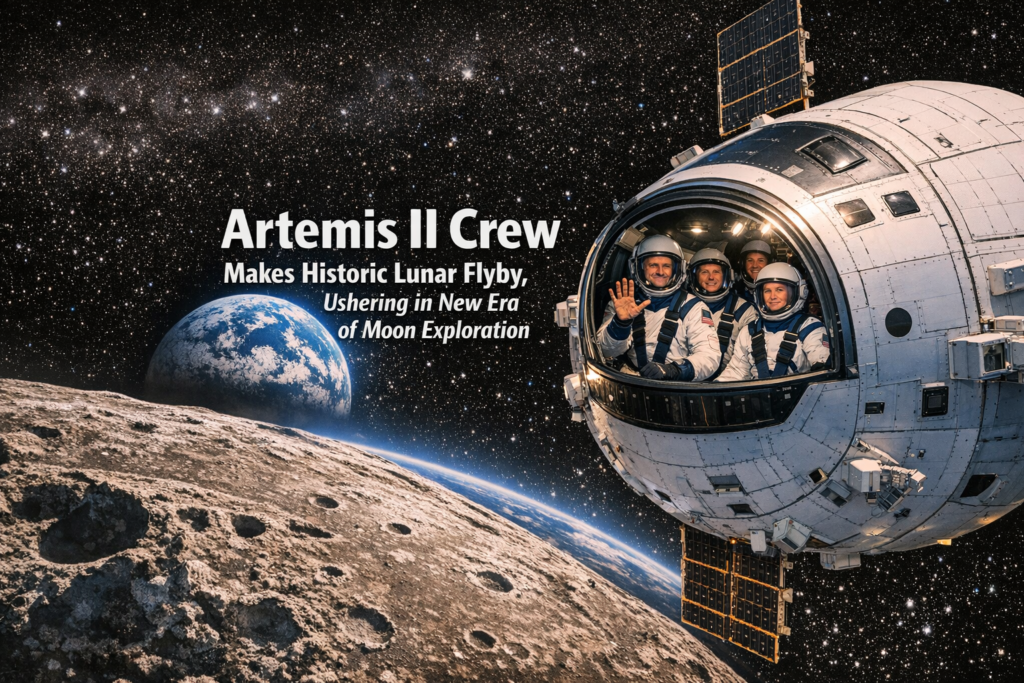
More than 50 years have passed since humans last traveled this far from Earth. When Apollo 17 concluded in December 1972, it ended an extraordinary chapter in history and left the Moon silent for generations. Since then, astronauts have remained in Earth orbit, living and working aboard space stations while robotic probes explored the solar system. Artemis II changes that narrative. It represents humanity’s long-awaited return to deep space and serves as a reminder that the ambition to explore worlds beyond our own has never disappeared.
READ MORE ARTICLES:
- Artemis II Crew Makes Historic Lunar Flyby, Ushering in New Era of Moon Exploration
- Artemis II | NASA, Voyage, Mission & Moon
- NASA’s Artemis II Departs Earth Orbit for Historic Moon Flyby
- NASA: The Artemis Generation Takes Flight with Historic Artemis II Mission
The Artemis II mission is NASA’s first crewed voyage around the Moon under its ambitious Artemis program, which aims to establish a long-term human presence on the lunar surface. Unlike the Apollo era, where the goal was largely symbolic and geopolitical, Artemis is focused on sustainability. NASA hopes future missions will create the foundation for lunar bases, scientific laboratories, and even staging points for eventual missions to Mars.
The mission lifted off on April 1, 2026, from the historic Kennedy Space Center in Florida, where thousands of spectators gathered to witness the thunderous departure of the Space Launch System, or SLS. Towering over the launch pad, the SLS is the most powerful rocket NASA has ever developed, capable of generating enough thrust to send astronauts far beyond Earth’s orbit. As the engines roared to life and the rocket climbed into the sky, the launch symbolized more than technological achievement it represented decades of planning, billions of dollars in investment, and the hopes of a new generation inspired by the dream of space exploration.
Inside the Orion spacecraft are four astronauts chosen to lead humanity back into deep space. Mission commander Reid Wiseman, pilot Victor Glover, mission specialist Christina Koch, and Canadian astronaut Jeremy Hansen are spending ten days traveling around the Moon and returning safely to Earth. Each crew member brings years of experience and unique significance to the mission. Their journey is not only a technical demonstration of the Orion spacecraft’s capabilities, but also a test of how astronauts can live and work together during future deep-space missions.
During the flight, the astronauts are evaluating the Orion capsule’s navigation systems, communications equipment, power systems, and life-support technologies. Every maneuver, system check, and course correction is being closely monitored by engineers on Earth. NASA considers Artemis II a crucial proving ground because future missions will depend on the success of these tests. Before astronauts can once again walk on the lunar surface, NASA must prove that Orion can safely transport crews into deep space and back home.
The mission’s lunar flyby is among its most historic moments. As Orion passes around the far side of the Moon, the crew temporarily loses direct communication with Earth, recreating one of the most dramatic experiences of the Apollo missions. During this period, the astronauts witness views few humans have ever seen: the barren lunar landscape below them and the distant blue Earth rising over the horizon. These moments serve as a powerful reminder of both the vastness of space and the fragility of the planet humanity calls home.
NASA officials have described Artemis II as the critical bridge between uncrewed testing and future lunar landings. If the mission is successful, Artemis III could bring astronauts back to the Moon’s surface for the first time since Apollo 17. Future missions are also expected to include the first woman and the first person of color to walk on the Moon, reflecting NASA’s effort to make the new era of exploration more inclusive and representative.
The Artemis program is also an international effort. Canada, Europe, and other allied nations are contributing technology, funding, and personnel to future lunar missions. Jeremy Hansen’s participation as the first Canadian assigned to a lunar mission highlights the growing global cooperation behind space exploration. In many ways, Artemis is not simply an American mission it is a worldwide project that reflects humanity’s shared desire to push beyond known boundaries.
As Artemis II completes its historic journey around the Moon, the mission stands as a powerful symbol of what is possible when science, technology, and human determination come together. After more than five decades, humanity is once again venturing into deep space—not merely to revisit the past, but to build the future.
A Historic Launch Captivates the World as Artemis II Begins Its Journey to the Moon
The launch of Artemis II became far more than a scientific milestone it evolved into a global spectacle that rekindled memories of the Apollo era and reminded the world of humanity’s enduring fascination with space exploration. Across Florida’s Space Coast, hundreds of thousands of people gathered along highways, beaches, parks, and viewing sites to witness the dramatic ascent of NASA’s most powerful rocket.
Long before sunrise, roads leading to Kennedy Space Center were already crowded with spectators eager to catch a glimpse of history. Families camped overnight, tourists filled hotels, and longtime space enthusiasts carried cameras, flags, and memorabilia, all hoping to witness the moment Artemis II roared into the sky. The atmosphere echoed the excitement of the 1960s and 1970s, when Apollo missions drew enormous crowds and turned each launch into a defining national event.
As the engines of the Space Launch System ignited, the ground shook across Florida’s coast. A brilliant column of fire and smoke illuminated the night sky, drawing cheers, tears, and applause from the massive audience below. For many watching, it was not merely a rocket launch it was the symbolic return of humanity to deep space after decades of waiting.
Beyond the crowds gathered in Florida, millions of viewers around the world followed the event through live broadcasts and online streams. Social media platforms were flooded with reactions, videos, and images as people from different countries watched the astronauts begin their voyage around the Moon. The mission quickly became one of the most widely viewed space events in recent years, uniting audiences across continents in a shared moment of wonder and anticipation.
Soon after reaching orbit, the Artemis II crew began a series of critical checks aboard the Orion spacecraft. Astronauts carefully evaluated the capsule’s life-support systems, navigation controls, communication equipment, and propulsion systems to ensure that everything was operating as planned. These early tests were essential because the success of the mission depended on Orion functioning flawlessly in the harsh environment of deep space.
Within the first 24 hours of flight, NASA flight controllers approved one of the mission’s most important maneuvers: the translunar injection burn. During this six-minute engine firing, Orion accelerated to a speed that allowed it to break free from Earth’s gravitational pull and begin its path toward the Moon. Once this maneuver was completed, there was no option to simply turn around or end the mission early. The astronauts were fully committed to a long loop around the Moon before returning home.
NASA officials stressed that Artemis II is, above all, a demanding test mission. Unlike previous uncrewed flights, this mission is carrying astronauts, meaning every system must perform perfectly under real conditions. Engineers and mission managers view Artemis II as a crucial step toward future lunar landings, as it will provide valuable data about how Orion performs with a crew onboard.
Following the successful translunar injection burn, NASA flight directors acknowledged the immense risks involved in the mission. They noted that once the spacecraft commits to leaving Earth orbit, there is no margin for failure. Every component from the engines and heat shield to the onboard computers and life-support systems must work exactly as intended. In many ways, Artemis II is not only a test of technology, but also a test of confidence in humanity’s ability to venture once again into deep space.
Artemis II Sets the Stage for Humanity’s Return to the Moon
NASA officials have repeatedly emphasized that Artemis II is not simply a dramatic display of technological power or a symbolic journey around the Moon. More importantly, it is a critical rehearsal for the missions that will follow especially Artemis III, which is expected to place astronauts back on the lunar surface for the first time since the Apollo era. Every maneuver, every communication test, and every system check performed during Artemis II is designed to provide valuable information that will shape the future of human exploration beyond Earth.
The mission serves as the foundation for NASA’s broader Artemis campaign, which aims not only to revisit the Moon, but to create a lasting and sustainable presence there. Engineers and scientists will study data gathered from Orion’s life-support systems, propulsion, navigation, radiation shielding, and crew performance in deep space. These lessons will be essential in preparing astronauts for longer, more complex missions in the years ahead.
Artemis III, which NASA hopes to launch later this decade, is expected to take the next historic step by landing astronauts near the Moon’s south pole. Unlike the Apollo missions, which focused mainly on brief visits to the lunar surface, future missions will concentrate on areas believed to hold resources that could support long-term exploration. The Moon’s south polar region has become a major focus because permanently shadowed craters there may contain large amounts of frozen water. That water could eventually be converted into drinking supplies, breathable oxygen, and even rocket fuel, making it one of the most valuable resources for sustaining future human activity on the Moon.
To make those landings possible, NASA is working closely with private aerospace companies that are developing the next generation of lunar transportation systems. Companies such as SpaceX and Blue Origin are expected to play major roles in delivering astronauts from lunar orbit to the surface and back again. Their involvement represents a major shift in the future of spaceflight, where government agencies and commercial partners work side by side to achieve goals that once seemed impossible.
Beyond its scientific and technological goals, the Artemis program also reflects a larger global competition unfolding in space. As nations around the world increase their investments in lunar exploration, the Moon has once again become a symbol of national prestige, influence, and strategic leadership. China, in particular, has rapidly expanded its space ambitions and has announced plans for its own crewed lunar missions in the coming years. In response, American officials have described Artemis as more than a research initiative, it is also an effort to reinforce the United States’ leadership in space while deepening partnerships with allied nations.
The international nature of Artemis is already visible in the crew of Artemis II itself, which includes Canadian astronaut Jeremy Hansen alongside his American crewmates. NASA’s partnerships with other countries are expected to grow even stronger as more nations contribute technology, scientific instruments, and personnel to future lunar missions. In this way, Artemis is not only a national project, but a global effort to expand humanity’s reach into the solar system.
When Orion eventually splashes down in the Pacific Ocean later this month, Artemis II will mark the end of a mission unlike any other in modern history. More than fifty years after the final Apollo mission, humans will once again have traveled beyond low Earth orbit and returned safely from the Moon’s distant neighborhood. The mission will close a 53-year gap in human lunar exploration and prove that NASA still possesses the capability to send astronauts deep into space.
Artemis II is not simply about revisiting the past. It represents the beginning of a new era—one defined not by short visits and symbolic footprints, but by long-term goals of exploration, settlement, and sustainability. NASA is no longer aiming only to plant flags on the Moon; it is preparing to build the systems and infrastructure needed for humans to remain there for extended periods of time.
For many, Artemis II serves as a powerful reminder of what humanity can accomplish when science, ambition, and international cooperation come together. As Earth faded into the distance behind the Orion spacecraft, appearing only as a glowing blue crescent in the darkness of space, the mission captured the imagination of millions around the world. It demonstrated that the spirit of exploration remains alive and that humanity is once again ready to push beyond familiar boundaries.
Artemis II has done far more than complete a successful flight around the Moon. It has reopened the path to deep space, revived the dream of human lunar exploration, and laid the groundwork for a future in which people will not only return to the Moon but remain there for generations to come.
Sources
Artemis II astronauts bound for moon after rocketing away on NASA’s first lunar voyage in decades
NASA’s Artemis II Mission Leaves Earth Orbit for Flight around Moon
NASA’s Artemis II Mission Leaves Earth Orbit for Flight around Moon – NASA
Artemis II astronauts closer to moon than Earth amid toilet malfunction
- D-F CELE March 2026 Results Civil Engineer Licensure Exam List of Passers
- A-C CELE March 2026 Results Civil Engineer Licensure Exam List of Passers
- CELE March 2026 RESULTS: Civil Engineer Licensure Exam List of Passers
- March 2026 PLE Results: Complete List of Physician Licensure Exam Passers
- ICC Sets April 22 Ruling on Rodrigo Duterte Jurisdiction Appeal
- LET Results March 2026 Elementary and Secondary List of Passers
- Artemis II Crew Makes Historic Lunar Flyby, Ushering in New Era of Moon Exploration
- PNP Sustains Full-Scale Holy Week Operations, Seizes ₱121.6 Million in Illegal Drugs and Contraband
- Pag-aaral ng Kasaysayan at Lipunang Pilipino
- RESULTS: March 2026 LET Elementary List Passers
- RESULTS : March 2026 LET Secondary List Passers
- Day 36 of the US-Israel Attacks on Iran
- Iran Hangs Abolhassan Montazer & Vahid Baniamerian After Supreme Court Upholds Death Sentences
- Party-Lists Named in DPWH P14.4-B ‘Wishlist’ Project Leak
- TMZ Founder Harvey Levin Targets Congress with Vacation Photos Amid Historic Government Shutdown
- Worst Country I’ve Visited- Thailand Girl, Stark Warning After Disappointing Vietnam Trip
- Artemis II | NASA, Voyage, Mission & Moon
- A Prayer of Thanksgiving for Divine Blessings, Triumph, Forgiveness, and Good Health
- NASA’s Artemis II Departs Earth Orbit for Historic Moon Flyby
- NASA: The Artemis Generation Takes Flight with Historic Artemis II Mission
- Victor Glover | Life, Education & NASA Career
- Philippines vs China, When Betrayal Comes from Within: The Cost of Selling a Nation
- Court’s Final Decision Favors Rappler in 2018 SEC Shutdown Case
- Supreme Court Affirms Dismissal of GMA Network’s Complaint Against ABS-CBN Over TV Ratings Dispute
- List of political ideologies
- Andrew Heywood | British author, Educationalist, & political theorist
- Holy Wednesday: A Solemn Reminder on Judas Iscariot Betrayal of Jesus Christ
- Judas Iscariot | About in the Bible, Betrayal & Apostle
- Relief or Rhetoric? Imee Marcos’ Call to Suspend Government Deductions Remains Without Action—Just Words
- Gatchalian Renews Push to Keep Minors Off Social Media
- Donald Trump Floats Seizing Iran’s Kharg Island Oil Hub, Wider Middle East Conflict
- Kharg Island | Geography, Historical and Importance of Iran
- Mary, mother of Jesus Christ
- SURVEY: Who would you vote as Philippine President in 2028?
- Matty Juniosa Gets Golden Buzzer on Britain’s Got Talent