Victor Jerome Glover Jr., born April 30, 1976, has forged a career defined by technical excellence, operational leadership, and historic firsts in American spaceflight. A U.S. Navy captain, accomplished test pilot, and member of NASA’s Astronaut Group 21, Glover has steadily risen through the ranks of military aviation and human space exploration to become one of the most prominent figures of a new generation of astronauts.
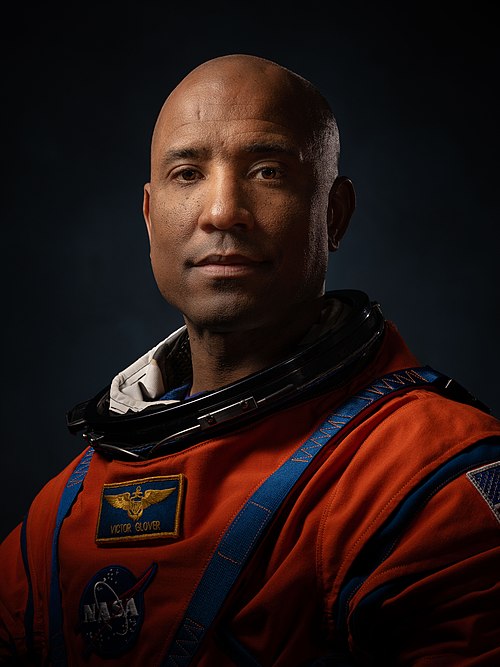
Before entering the astronaut corps, Glover served as an F/A-18 pilot in the U.S. Navy, mastering one of the military’s premier strike fighters in demanding operational environments. His pursuit of technical mastery led him to graduate from the U.S. Air Force Test Pilot School, an elite institution known for producing aviators capable of evaluating and advancing the nation’s most sophisticated aircraft systems. The rigorous training refined his engineering insight and flight-test precision qualities that would later prove invaluable at NASA.
Glover first captured global attention when he piloted the inaugural operational flight of SpaceX’s Crew Dragon spacecraft to the International Space Station. That mission marked a turning point in commercial human spaceflight, demonstrating that a new generation of spacecraft could reliably transport astronauts to orbit. During his time aboard the station as part of Expedition 64, Glover served as a systems flight engineer, contributing to scientific research, maintenance operations, and the daily management of one of humanity’s most complex orbital laboratories.
On April 1, 2026, Glover added another milestone to his already distinguished résumé. He launched as pilot of the Artemis II mission NASA’s first crewed voyage beyond low Earth orbit in more than five decades. The mission, designed to conduct a sweeping lunar flyby, represents a crucial step toward returning astronauts to the Moon’s surface.
With that launch, Glover made history as the first person of color to travel beyond low Earth orbit. If Artemis II completes its mission as planned, he will also become the first person of color to journey into the Moon’s vicinity a powerful symbol of how the face of space exploration continues to evolve. His role aboard Artemis II not only reflects his exceptional credentials as a naval officer and test pilot, but also underscores NASA’s broader commitment to expanding opportunity and representation in the next era of deep-space exploration.
From fighter cockpits to orbital spacecraft and now toward lunar distance, Glover’s career traces the arc of a modern space pioneer one whose achievements bridge military aviation, commercial innovation, and humanity’s renewed quest to explore beyond Earth.
Early life and education
Long before he would pilot spacecraft beyond Earth’s orbit, Victor Jerome Glover Jr.’s journey began in Pomona, California, where he was born on April 30, 1976, to a Caribbean American mother and a Black American father. Raised in a family that valued perseverance and education, Glover’s early years were shaped by both inspiration and legacy. His grandfather had served in the U.S. Air Force during the Korean War era, confronting racial barriers that limited his opportunities in aviation a history that would later add deeper meaning to Glover’s own ascent in the aerospace world.
A standout student-athlete at Ontario High School, Glover graduated in 1994 after earning recognition as the school’s Athlete of the Year. On the football field, he showcased versatility and leadership as both quarterback and running back for the Jaguars, demonstrating the competitive drive and discipline that would define his future career. Yet athletics was only part of his story. His fascination with science and engineering, nurtured by his father, steadily guided him toward a path that blended technical rigor with operational excellence.
Glover went on to attend California Polytechnic State University in San Luis Obispo, where he earned a Bachelor of Science degree in general engineering in 1999. At Cal Poly, he distinguished himself not only academically but also athletically and socially. He joined the Mustangs wrestling team after an impressive sixth-place finish at the CIF State Championship Meet, underscoring his competitive edge. He also suited up for the university’s football team during the 1996 season, playing defensive back and wearing number 23. During his time on campus, he became a member of the Phi Beta Sigma fraternity, building lifelong bonds and leadership experience that complemented his academic pursuits.
Glover’s appetite for learning did not end with his undergraduate degree. Between 2007 and 2010, he achieved an extraordinary academic milestone, earning three master’s degrees from three separate institutions. He obtained a Master of Science in Flight Test Engineering from the U.S. Air Force’s Air University at Edwards Air Force Base in California, sharpening the technical expertise required to evaluate advanced aircraft systems. He also earned a Master of Science in Systems Engineering from the Naval Postgraduate School in Monterey, California, broadening his understanding of complex, integrated technologies. Completing the trio, he received a Master of Military Operational Art and Science from Air University in Montgomery, Alabama, reflecting his strategic and operational acumen.
In addition to these advanced degrees, Glover holds a certificate in space systems from the Naval Postgraduate School and a certificate in legislative studies from Georgetown University credentials that reveal a professional equally comfortable navigating engineering challenges and policy discussions.
Behind his professional achievements stands a strong family foundation. Glover is married to Dionna Odom Glover, and together they are raising four daughters. As he has advanced from student-athlete to naval officer, test pilot, astronaut, and lunar mission pilot, family has remained central to his journey.
From the playing fields of Southern California to the halls of elite military institutions and ultimately to the edge of deep space, Victor Glover’s life story reflects determination, intellect, and the breaking of barriers once thought insurmountable — a trajectory as inspiring as the missions he now helps lead.