Genghis Khan, the founder of the Mongol Empire, is known by several other names and titles, which can be categorized by the stage of his life or the language and culture in which they originated. Temuchin or Temujin (common English spellings of the same name). Temüjin—also rendered as Temuchin—was the birth name of the 13th-century Mongol leader who would later rise to prominence as Genghis Khan. Born around 1162, he was bestowed a name meaning “blacksmith” or “iron worker,” a fitting symbol of strength and resilience. In 1206, after forging unity among the once-fractured nomadic tribes of Mongolia, he emerged as the founding ruler of the vast Mongol Empire.
Around 1162, a boy named Temüjin entered the world. It would be many years and many triumphs later that he would be recognized with the powerful title of Genghis Khan.
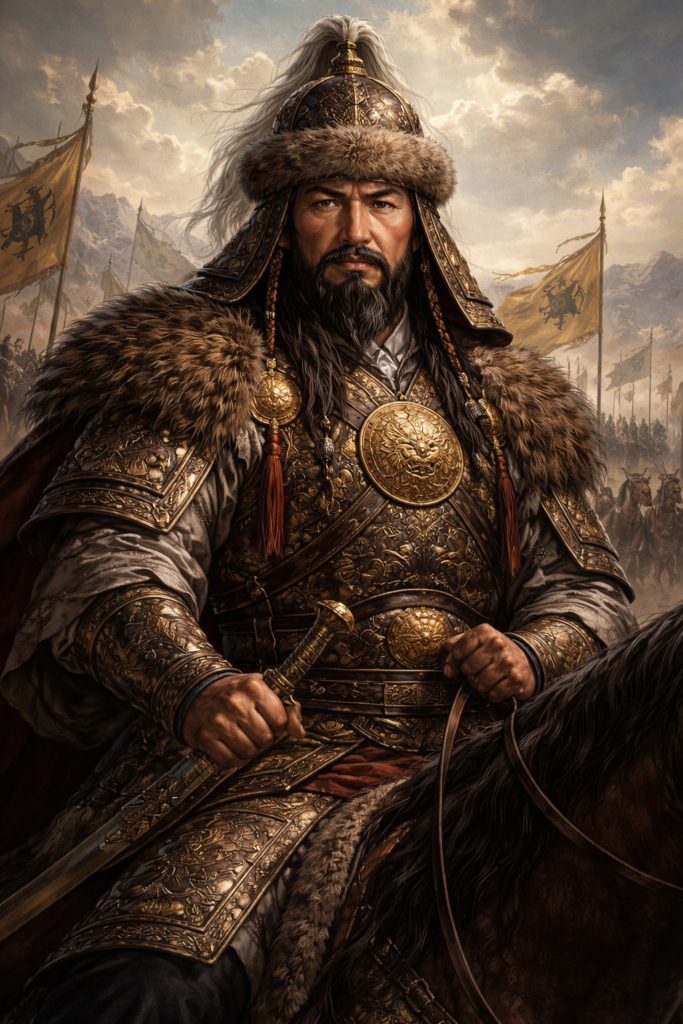
Titles associated with Genghis Khan:
- Temüjin (also spelled Temujin) – His birth name. Temüjin (or Temujin): This was his birth name, given to him by his father Yesügei. It is believed to be derived from the Mongolian word temur, meaning “iron,” possibly indicating “blacksmith”
- Chinggis Khan – The original Mongolian spelling of his title. Chinggis Khan (or Chinggis Khaan) — The preferred modern Mongolian spelling and pronunciation. “Chinggis” (or Činggis) likely means “universal,” “oceanic,” or “supreme/fierce ruler.”
- Jenghiz Khan – An alternate transliteration.
- Genghis Khan (or Chinggis Khan): He adopted this title in 1206 when he united the Mongol tribes. While its exact meaning is debated, it is generally understood to mean “Universal Ruler” or “Oceanic Ruler”
- Zhinghis Khan – Another spelling variation.
- Great Khan – A title meaning supreme ruler. Great Khan (or Khagan): As the leader of the vast Mongol Empire, his full title was “Khagan,” meaning “Khan of Khans,” the supreme ruler of all Mongol tribes
- Khan of Khans – Meaning ruler over all khans.
- Emperor Taizu of Yuan – His posthumous title in the Yuan dynasty.
- Saint Emperor – An honorific title used in some historical references.
READ MORE:
- Hector De Leon
- Alexandra Eala
- Sanae Takaichi
- Mojtaba Khamenei
- Donald J. Trump
- Titus Low
- Who is Clarita Carlos?
- Zyan Cabrera
- Iulia Motoc
Alternative Spellings and Cultural Variants
Due to transliteration from Mongolian, Persian, and Chinese into English, his name has many variant spellings.
- Chinggis Khan, Chingiz Khan
- Jenghiz Khan, Jinghis Khan
- Chengiz Khan, Jengiz Khan
- Zing his kan (an early European variant)
You may also encounter the name Tamarchi or Tamurchi, which appears in some early Iranian sources and also relates to the meaning of “ironsmith”
- uan Taizu (Chinese temple name/posthumous title used in the Yuan Dynasty he founded) — Meaning “Supreme Ancestor of the Yuan.”
- He belonged to the Borjigin clan (sometimes written as Borjigin Temüjin in fuller references), though Mongols at the time did not use surnames in the modern sense.
Genghis Khan is not his birth name but a title he received at a grand assembly (kurultai) in 1206 after uniting the Mongol tribes. It roughly translates to “universal ruler” or “supreme leader.” The variation in spellings comes from different languages (Mongolian, Persian, Arabic, Chinese, etc.) and how they transcribed the sounds. The most historically precise ways to refer to him are Temüjin (early life) and Chinggis Khaan (as ruler)
Genghis Khan—born Temüjin around 1162 and also known as Chinggis Khan—rose from obscurity to become the founder and first Great Khan of the Mongol Empire. After dedicating much of his early life to unifying the fractured Mongol tribes, he embarked on sweeping military campaigns that brought vast regions of China and Central Asia under his dominion.
Temüjin, born between 1155 and 1167, was the eldest son of Yesugei, a chieftain of the Borjigin clan, and his wife, Hö’elün. His childhood was marked by hardship. When he was only eight years old, his father died, and his family was cast out by their tribe, plunging them into extreme poverty. In a decisive and controversial act to secure his standing within the family, the young Temüjin killed his elder half-brother, Behter.
Despite these turbulent beginnings, Temüjin’s magnetic leadership and strategic insight gradually earned him loyal followers. He forged crucial alliances with two influential steppe leaders, Jamukha and Toghrul, and together they rescued his wife, Börte, after she was abducted by raiders. Yet as Temüjin’s influence expanded, rivalry with Jamukha turned into bitter conflict. Suffering a major defeat around 1187, he may have spent several years under the authority of the Jin dynasty.
Reemerging in 1196 with renewed determination, Temüjin rapidly consolidated power. When Toghrul perceived him as a rising threat and launched a surprise attack in 1203, Temüjin regrouped and decisively defeated him. With the subsequent conquest of the Naiman tribe and the execution of Jamukha, Temüjin stood unrivaled as the supreme ruler of the Mongolian steppe—poised to reshape the course of world history.
Temüjin officially took the title “Genghis Khan” (whose exact meaning remains uncertain) during a grand assembly in 1206. To promote long-term stability, he introduced major reforms that reshaped the Mongols’ traditional tribal system into a unified, merit-based organization fully loyal to the ruling family. After successfully suppressing a coup led by a powerful shaman, he strengthened his authority further.
In 1209, Genghis Khan launched a major raid against the neighboring Western Xia kingdom, which submitted to Mongol demands the next year. He then waged a four-year campaign against the Jin dynasty, culminating in 1215 with the capture of their capital, Zhongdu. In 1218, his general Jebe conquered the Central Asian state of Qara Khitai. The following year, after the Khwarazmian Empire executed his envoys, Genghis invaded and completely destroyed that empire, devastating the regions of Transoxiana and Khorasan. Meanwhile, Jebe and Subutai conducted a remarkable expedition that extended as far as Georgia and Kievan Rus’.
In 1227, Genghis Khan died during his campaign to suppress a rebellion in Western Xia. After a two-year interregnum, his third son and designated successor, Ögedei, ascended to the throne in 1229.
Genghis Khan is a highly controversial historical figure. He was known for his generosity and fierce loyalty toward his followers, yet he showed no mercy to his enemies. He actively sought advice from a wide range of sources as he pursued what he believed was his divine destiny — granted by the shamanic supreme god Tengri — to conquer the world. While the Mongol armies under his command caused the deaths of millions, his conquests also created the largest contiguous empire in history and enabled unprecedented levels of trade and cultural exchange across vast distances.
He is still remembered as a brutal and savage tyrant in Russia and much of the Arab world. In contrast, recent Western scholarship has started to move away from the traditional image of him as a mere barbarian warlord and has begun reevaluating his legacy more nuancedly. In Mongolia, he was deified after his death and is widely revered today as the founding father of the Mongolian nation.
Early life
The exact year of Temüjin’s birth remains shrouded in uncertainty, with historians debating three main possibilities: 1155, 1162, or 1167. Traditional accounts sometimes link his birth to the Year of the Pig, pointing to either 1155 or 1167.
Support for 1155 comes from the writings of the Song envoy Zhao Hong and the Persian historian Rashid al-Din. However, major Mongolian and Chinese sources, including the History of Yuan and the Shengwu, lean toward 1162 — the date now accepted by the majority of modern historians. The 1167 dating, championed by the renowned sinologist Paul Pelliot, draws from a lesser-known text by the Yuan artist Yang Weizhen. It has the advantage of aligning more convincingly with the timeline of Temüjin’s life, as a 1155 birth would mean he fathered children only after turning thirty and was still leading military campaigns well into his seventies.
As historian Paul Ratchnevsky wryly observed, even Temüjin himself may not have known his true age with certainty.
The place of his birth is equally contested. According to The Secret History of the Mongols, Temüjin was born at Delüün Boldog, along the banks of the Onon River. Scholars continue to debate whether this site lies near Dadal in Mongolia’s Khentii Province or further south in the Agin-Buryat Okrug of Russia.
This version maintains scholarly precision while elevating the language with smoother flow, subtle drama, and refined phrasing — making it far more engaging and authoritative.
Temüjin was born into the noble Borjigin clan of the Mongol people. His father, Yesügei, was a respected chieftain who proudly traced his lineage back to the legendary warrior Bodonchar Munkhag. His mother, Hö’elün, originally from the influential Olkhonud clan, had been abducted by Yesügei from her Merkit bridegroom, Chiledu, and became his principal wife.
The origin of Temüjin’s name has long been debated. Early traditions claim that Yesügei, fresh from a victorious campaign against the Tatars, named his newborn son after a captured Tatar chief called Temüchin-uge as a triumphant celebration of his success. Later accounts, however, emphasize the Mongolian root temür (“iron”), suggesting that Temüjin carries the meaning “blacksmith” or “man of iron.”
Several striking legends surround his birth. The most famous tells that he entered the world still clutching a blood clot in his tiny fist a powerful omen in steppe folklore foretelling that the child was destined to become a great warrior. Another tale claims that Hö’elün was visited by a divine ray of light that foretold the boy’s extraordinary fate, mirroring the mythical origin story of their Borjigin ancestor, Alan Gua.
Yesügei and Hö’elün later had three more sons — Qasar, Hachiun, and Temüge — and one daughter, Temülün. Temüjin also had two half-brothers, Behter and Belgutei, born to Yesügei’s secondary wife, Sochigel.
The siblings spent their early years in Yesügei’s main camp along the banks of the Onon River, where they mastered the essential skills of nomadic life: riding horses and shooting with the bow.
When Temüjin was just eight years old, his father took him to the pastures of the prestigious Onggirat tribe his mother’s people, long allied with the Mongols through marriage. There, Yesügei arranged for Temüjin to be betrothed to Börte, the daughter of the Onggirat chieftain Dei Sechen. Because the alliance was valuable and Börte carried a high bride price, Dei Sechen held the upper hand in negotiations. He insisted that Temüjin remain in his household to work and prove himself.
Accepting the terms, Yesügei began his journey home alone. Along the way, he stopped for a meal with a group of Tatars, trusting in the ancient steppe custom of hospitality to strangers. The Tatars, however, recognized their old enemy and secretly poisoned his food. Yesügei managed to ride home despite growing weaker, and on his deathbed, he instructed his loyal retainer Münglig to bring Temüjin back from the Onggirat. Shortly afterward, the chieftain died.
Adolescence
The death of Yesügei dealt a devastating blow to the fragile unity of his followers. His camp, which had included members of the Borjigin, Tayichiud, and several allied clans, quickly fractured. Since Temüjin was not yet ten years old and his half-brother Behter was only slightly older, neither boy was deemed mature enough to assume leadership.
The powerful Tayichiud faction wasted no time in sidelining Hö’elün. They excluded her from the sacred ancestor worship rituals traditionally held after a chieftain’s death and soon deserted her camp entirely. According to The Secret History of the Mongols, the rest of the Borjigin clan followed suit, abandoning the widow and her children despite Hö’elün’s passionate attempts to shame them into staying by invoking their sense of honor and loyalty.
Other sources, such as Rashid al-Din and the Shengwu, present a slightly different picture, suggesting that some of Yesügei’s brothers initially remained loyal to the family. It is possible that Hö’elün refused to enter into a levirate marriage with one of them — a common steppe custom — which may have created lasting resentment. Alternatively, the author of The Secret History may have deliberately dramatized the abandonment to heighten the narrative of hardship and resilience.
What remains clear across all accounts is that the majority of Yesügei’s people deserted his family in favor of the Tayichiuds. Overnight, Hö’elün and her children were stripped of their status and reduced to a life of extreme poverty and struggle.
Forced to survive on their own, the family adopted a harsh hunter-gatherer existence. They foraged for roots and wild nuts, hunted small game, and fished in the rivers to feed themselves a far cry from the privileged life of a chieftain’s household.
As the children grew older, dangerous tensions began to simmer within the fractured family. Both Temüjin and his half-brother Behter had legitimate claims to leadership: Temüjin was the son of Yesügei’s principal wife, but Behter held the advantage of being at least two years older. Under the steppe custom of levirate marriage, there was even the unsettling possibility that Behter could one day marry Hö’elün and become Temüjin’s stepfather.
Friction escalated through constant quarrels over the division of precious hunting spoils. The rivalry finally exploded when Temüjin and his younger brother Qasar ambushed and killed Behter. This grave and taboo act of fratricide was deliberately omitted from official chronicles, but The Secret History of the Mongols records it in stark detail, describing how Hö’elün furiously rebuked her sons for their unforgivable deed.
Remarkably, Behter’s full younger brother, Belgutei, chose not to seek revenge. Instead, he remained loyal and eventually rose to become one of Temüjin’s most trusted and highest-ranking companions, alongside Qasar.
Around this turbulent period, Temüjin formed a deep and fateful friendship with Jamukha, a boy of equally noble birth. According to The Secret History, the two youths exchanged knucklebones and arrows as tokens of affection and, at the age of eleven, swore the sacred anda pact the solemn Mongol oath of blood brotherhood.
With the family dangerously isolated and lacking powerful allies, Temüjin was captured several times during these vulnerable years. Once, after being seized by the Tayichiuds, he managed a daring escape during a feast. He first hid in the waters of the Onon River, then took refuge in the tent of a sympathetic man named Sorkan-Shira, who had spotted him in the river but deliberately stayed silent. At great personal risk, Sorkan-Shira sheltered the young fugitive for three days before helping him slip away to safety.
On another occasion, a brave adolescent named Bo’orchu came to Temüjin’s aid, helping him recover a herd of stolen horses. Impressed by the boy’s courage and loyalty, Bo’orchu soon joined Temüjin’s small camp as his first nökör a personal companion and sworn follower.
These dramatic episodes, vividly preserved in The Secret History, highlight the author’s emphasis on Temüjin’s extraordinary personal charisma and his remarkable ability to inspire unwavering loyalty even in the darkest moments of his youth.
Early Campaigns: Forging Alliances and Enduring Betrayal
At the foot of the sacred Burkhan Khaldun, the mountain that had once sheltered Temüjin during his darkest hour, a young man stepped into manhood. Having reached the age of fifteen, he returned to Dei Sechen to claim his bride, Börte. The old chief, overjoyed to see the son-in-law he had long believed dead, gladly gave his consent. With pride, Dei Sechen and his wife Čotan escorted the newlyweds back to Temüjin’s humble camp. There, Čotan presented Hö’elün with a magnificent sable cloak a gift of rare luxury and prestige.
Eager to secure powerful patronage, Temüjin made a shrewd and symbolic choice: he offered the priceless cloak to Toghrul, the formidable Khan of the Kerait tribe. Toghrul had once fought beside Yesügei and sealed their bond with the sacred anda pact. Ruling over vast territories in central Mongolia, Toghrul was surrounded by men he could no longer fully trust. In desperate need of loyal allies, he received the sable cloak with genuine delight and warmly extended his protection to the young Temüjin.
This generous gesture marked the beginning of a deep and fruitful relationship. Under Toghrul’s wing, Temüjin began to attract his first devoted followers — nököd — including the formidable warrior Jelme. Around this same time, Börte gave birth to their first child, a daughter named Qojin.
Seeking vengeance for Yesügei’s long-ago abduction of Hö’elün, roughly three hundred Merkits launched a sudden and brutal raid on Temüjin’s camp. While Temüjin and his brothers escaped to the protective slopes of Burkhan Khaldun the mountain he would later venerate as sacred Börte and Sochigel were captured. In keeping with levirate custom, Börte was given as wife to the younger brother of the deceased Chiledu.
Determined to rescue his bride, Temüjin turned to his two most powerful allies: his patron Toghrul and his childhood anda Jamukha, who had risen to lead the Jadaran tribe. Both leaders responded decisively, each committing an army of 20,000 warriors. With Jamukha taking overall command, the campaign was swift and victorious.
Börte was recovered though now pregnant. Soon after, she gave birth to a son, Jochi. Temüjin raised the boy as his own, but whispers about the child’s true paternity would shadow Jochi for the rest of his life. This dramatic episode is vividly recounted in The Secret History of the Mongols, while the later historian Rashid al-Din, ever protective of the imperial family’s honor, carefully omits any suggestion of illegitimacy.
In the years that followed, over the next decade and a half of relative stability and growing strength, Temüjin and Börte were blessed with three more sons — Chagatai, Ögedei, and Tolui and four daughters: Checheyigen, Alaqa, Tümelün, and Al-Altan.
Thus, amid hardship, sacred refuge, calculated alliances, and hard-won victories, the foundation of one of history’s greatest legacies was quietly being laid.
The Breaking of the Anda: Ambition Awakens
For a year and a half, the followers of Temüjin and Jamukha camped side by side as one host. During this time, the two childhood friends renewed their sacred anda pact with solemn ceremony. According to The Secret History of the Mongols, they even slept together beneath a single blanket a powerful symbol of their renewed intimacy and trust. The source portrays this period as one of warm camaraderie and brotherly bonding.
Yet beneath the surface, questions lingered. Historian Paul Ratchnevsky wondered whether Temüjin had, in effect, temporarily entered Jamukha’s service as repayment for the decisive help he had received against the Merkits.
Eventually, tensions simmered and then boiled over. The official reason given was a cryptic remark by Jamukha about where and how they should pitch their camps an seemingly trivial dispute that masked deeper ambitions and clashing visions of leadership. In truth, the fracture had become inevitable.
Heeding the wise counsel of his mother Hö’elün and his wife Börte, Temüjin resolved to strike out on his own and forge an independent following.
When the inevitable split came, most of the major tribal chieftains chose to remain with Jamukha. However, forty-one leaders along with a great multitude of common warriors and their families threw their lot in with Temüjin. Among them were rising stars such as Subutai of the Uriankhai, along with warriors from the Barulas, the Olkhonuds, and many other clans.
What drew them was Temüjin’s growing reputation as a fair, generous, and visionary lord a man who promised not just survival, but a better life under a just and rewarding leader. Reinforcing this allure, his shamans proclaimed that Heaven itself had marked him for a magnificent destiny.
Thus, from the shadow of his powerful anda, Temüjin quietly began to assemble the core of what would one day become the greatest conquering force the world had ever seen.
Defeat, Exile, and Silent Ambition
Soon after the split with Jamukha, Temüjin’s loyal followers raised him on a felt carpet and acclaimed him khan of the Mongols a bold declaration of independence and rising destiny.
Toghrul, his Kerait patron, received the news with satisfaction, viewing the elevation of his vassal as a reflection of his own influence. Jamukha, however, reacted with bitter resentment. The old anda bond, already strained, now shattered completely.
Tensions rapidly spiraled into open warfare. Around 1187, the two former brothers-in-arms clashed at Dalan Baljut. Though the forces were roughly equal in strength, Temüjin suffered a decisive and humiliating defeat.
Later official Mongol chroniclers, including Rashid al-Din, attempted to rewrite this painful chapter, claiming victory for Temüjin. Yet their accounts are riddled with contradictions and internal inconsistencies, revealing the hand of imperial propaganda at work.
Modern historians, notably Paul Ratchnevsky and Timothy May, argue convincingly that in the years following Dalan Baljut roughly an entire decade Temüjin largely disappeared from the steppe and entered the service of the powerful Jurchen Jin dynasty in northern China. A contemporary Chinese envoy, Zhao Hong, explicitly recorded that the man who would become Genghis Khan spent several years as a servant even a slave of the Jin court.
What was once dismissed as Chinese arrogance is now taken seriously. No other source adequately explains Temüjin’s activities between his defeat at Dalan Baljut and his reemergence around 1195. For disaffected steppe leaders and fallen Chinese officials alike, seeking refuge or employment across the border was a well-established survival strategy.
Temüjin’s return to the steppe still possessing considerable authority and resources strongly suggests he had gained valuable experience, wealth, and political insight while serving the Jin. Yet this episode was profoundly embarrassing to Mongol pride. As the man who would later destroy the Jin Empire, any admission that he had once been their servant was deliberately erased from all native Mongol records. Official histories maintained a dignified silence.
Zhao Hong, writing as an outsider unbound by Mongol taboos, preserved the uncomfortable truth.
Thus, in the shadows of foreign service, the future conqueror of the world quietly honed his skills, bided his time, and prepared for his destined return.
The sources differ on the precise details of Temüjin’s reappearance on the steppe, yet one thing is clear: by 1196, he had returned with sharpened claws and renewed purpose.
In early summer of that year, he joined a Jin-led campaign against the unruly Tatars, who had grown defiant toward their nominal overlords. The Jurchen court, pleased with his contribution, bestowed upon him the prestigious title cha-ut kuri roughly translating to “commander of hundreds” a formal mark of recognition from one of the most powerful empires of the age.
Around the same time, Temüjin lent crucial support to his old patron Toghrul, helping him reclaim the leadership of the Kereit tribe after it had been seized by a relative backed by the mighty Naiman confederation. These twin successes of 1196 dramatically transformed Temüjin’s standing. Though he still paid nominal respect to Toghrul as his senior, in reality he had become a de facto equal a powerful ally rather than a subordinate.
Meanwhile, Jamukha’s victory at Dalan Baljut had soured into tyranny. In a display of shocking brutality, he allegedly boiled seventy prisoners alive and publicly mutilated the corpses of fallen enemy leaders. This cruelty proved too much for many. Several disillusioned warriors, including the veteran Münglig (a former follower of Yesügei) and his sons, defected to Temüjin’s camp. They were likely drawn not only by moral outrage but also by reports of Temüjin’s newfound wealth and growing prestige.
Emboldened, Temüjin moved swiftly to settle old scores. He turned against the arrogant Jurkin tribe, who had once insulted him at a feast and later refused to join the campaign against the Tatars. After capturing their leaders and executing them, he staged a symbolic act of vengeance: he ordered his half-brother Belgutei to break the back of a prominent Jurkin warrior in a ritual wrestling match. This brutal spectacle openly violated traditional Mongol customs of justice and honor. Only The Secret History of the Mongols records the incident — and its author clearly voiced disapproval at such ruthless retribution.
With these calculated moves rewarding loyalty, punishing betrayal, and demonstrating both mercy and mercilessness when needed Temüjin was no longer merely surviving. He was consolidating power.
The Road to Supremacy: Blood, Betrayal, and Rising Power
In the years that followed, Temüjin and Toghrul waged a series of relentless campaigns across the steppe, striking against the Merkits, Naimans, and Tatars — sometimes fighting side by side, sometimes pursuing their own objectives. Their combined strength seemed unstoppable.
Yet resentment was quietly gathering. Around 1201, a loose coalition of discontented tribes — including the Onggirat, Tayichiud, and Tatars — banded together in a desperate bid to shatter the growing dominance of the Borjigin-Kereit alliance. They elected Jamukha as their supreme leader, bestowing upon him the exalted title of gurkhan — “khan of the tribes.”
At first, the alliance enjoyed some success. But the tide turned decisively at Yedi Qunan, where Temüjin and Toghrul routed the confederation. Jamukha, once again humbled, was forced to crawl back and beg for Toghrul’s mercy.
With his eastern flank now clearing, Temüjin set his sights on total mastery of eastern Mongolia. He first crushed the defiant Tayichiud, then, in 1202, delivered a devastating blow to the Tatars — the ancient enemies of his people. In both campaigns, he showed ruthless calculation: the clan leaders were executed, while the surviving warriors were absorbed into his own ranks. Among those who joined him were Sorkan-Shira, the man who had once risked everything to help him, and a daring young warrior named Jebe. Jebe had earned his place in legend by boldly shooting Temüjin’s horse from under him in battle — then refusing to deny the deed. Impressed by such raw courage and martial skill, Temüjin not only spared his life but elevated him.
The destruction of the Tatars left only three major powers dominating the Mongolian steppe: the Naimans in the west, the Mongols in the east, and the Kereit caught in the middle.
Eager to secure his gains through diplomacy, Temüjin proposed a marriage alliance: his son Jochi would wed one of Toghrul’s daughters. The Kereit nobility, led by Toghrul’s ambitious son Senggum, saw through the move. They viewed it as a cunning attempt by Temüjin to infiltrate and eventually seize control of their tribe. Doubts surrounding Jochi’s true paternity only deepened the insult. Adding fuel to the fire, Jamukha warned the aristocracy that Temüjin’s dangerous habit of promoting low-born commoners to high command was eroding the traditional social order and threatening the power of the old noble houses.
Swayed by these arguments, Toghrul reluctantly agreed to betray his former protégé. He laid a trap, attempting to lure Temüjin into a deadly ambush. But the plot was overheard by two loyal herdsmen, who raced to warn their khan.
Temüjin managed to rally part of his forces in time, yet he was still overwhelmingly defeated at the Battle of Qalaqaljid Sands.
The Baljuna Covenant and the Fall of Empires
Driven back and bloodied, Temüjin retreated southeast to the shores of Baljuna — an obscure lake or river whose name would echo through history. There, amid uncertainty and loss, he waited as his scattered warriors trickled in. Bo’orchu, his loyal companion, had lost his horse and fled on foot like a common fugitive. His son Ögedei, gravely wounded, had been carried to safety and nursed by the brave warrior Borokhula.
Rather than despair, Temüjin turned crisis into destiny. He summoned every ally still loyal to him and there, at Baljuna, he swore a solemn and famous oath of unbreakable loyalty to his followers. This pact, forever known as the Baljuna Covenant, elevated those who stood by him in his darkest hour to positions of enduring prestige.
The men who sealed this covenant were remarkably diverse — a heterogeneous brotherhood drawn from nine different tribes. Among them were Christians, Muslims, and Buddhists, bound not by blood or clan, but by shared devotion to Temüjin and to one another. Historian John Man has aptly called this extraordinary gathering a “proto-government of a proto-nation,” a living blueprint for the vast, multi-ethnic empire that would one day emerge.
Notably, The Secret History of the Mongols omits any mention of the Baljuna Covenant. The author, eager to emphasize pure Mongol glory, likely chose to downplay the pivotal role played by non-Mongol warriors in Temüjin’s survival and rise.
From this moment of near-defeat, momentum shifted dramatically. Through a clever ruse involving his brother Qasar, Temüjin lured the Kereit into an ambush at the Jej’er Heights. Though the battle raged fiercely for three full days, it ended in crushing victory for the Mongols. Both Toghrul and his son Senggum were forced to flee. Senggum escaped toward Tibet, but the old Khan Toghrul was slain by a Naiman warrior who failed to recognize the once-mighty ruler.
Temüjin sealed his triumph with calculated mercy and strategy: he absorbed the Kereit elite into his own ranks. He took the princess Ibaqa as his wife, and arranged the marriages of her sister Sorghaghtani and niece Doquz to his youngest son, Tolui — forging powerful blood ties that would shape the empire’s future.
Only the Naimans now stood in his way. Their ranks had swollen with the arrival of Jamukha and other defeated remnants. Warned in advance by the sympathetic Ongud ruler Alaqush, Temüjin struck decisively. In May 1204, at the Battle of Chakirmaut in the Altai Mountains, the Naimans were utterly shattered. Their leader, Tayang Khan, was killed in battle, and his son Kuchlug fled westward into exile.
Later that same year, the Merkits were hunted down and decimated. Jamukha, who had abandoned the Naimans during the fighting at Chakirmaut, was betrayed by his own companions — men whom Temüjin promptly executed for their disloyalty.
According to The Secret History, Jamukha asked his childhood anda for an honorable execution, wishing to die without shedding blood. Other accounts claim he met a far grimmer end — torn apart by dismemberment.
With these final victories, the last major rivals had fallen. The steppe now lay open before one man.
Early reign: reforms and Chinese campaigns (1206–1215)
Kurultai of 1206 and reforms
In 1206, after years of relentless warfare and shrewd alliances had left him the undisputed master of the Mongolian steppe, Temüjin convened a grand assembly known as a kurultai along the banks of the Onon River. There, in a pivotal moment that would reshape world history, he was formally proclaimed Genghis Khan a title whose precise meaning scholars still debate. Some argue it carried no literal translation at all, serving merely as a deliberate break from the older, now-tainted title of gurkhan previously held by his rival Jamukha. Others interpret “Genghis” as evoking strength, firmness, or righteousness. A more evocative theory links it to the Turkic word tängiz (“ocean” or “sea”), suggesting “master of the ocean”—and, by extension, since the ocean was imagined to encircle the known world, a claim to universal rule.
A striking 15th-century illustration from the Jami’ al-tawarikh manuscript captures the scene: Temüjin stands elevated as the new supreme leader, with a white tuq a banner crafted from the tails of yaks or horses symbolizing peace positioned prominently beside him. (A black tuq would have signaled war.)
With his authority now absolute, Genghis Khan launched what historian Timothy May has aptly called a social revolution. Traditional tribal structures, evolved over centuries to serve small clans and kinship groups, had repeatedly proven inadequate for building stable, large-scale states; they had doomed earlier steppe confederations to fragmentation and collapse. Determined to prevent the same fate, Genghis implemented sweeping administrative reforms aimed at dismantling the old power of tribal loyalties and forging instead an unyielding allegiance to the khan and his ruling house.
The timing was fortunate: most of the entrenched traditional tribal chieftains had already been eliminated during his brutal rise to power. This power vacuum allowed Genghis to rebuild the Mongol social order almost entirely to his advantage. At the pinnacle stood the altan uruq (the “Golden Family”) or chaghan yasun (“white bone”) exclusively comprising his own immediate family and those of his brothers. Below them ranked the qara yasun (“black bone,” sometimes called qarachu), which included the remnants of the pre-imperial aristocracy along with the most favored and prominent new families elevated through loyalty and merit.
These reforms went far beyond mere hierarchy. Genghis reorganized the entire population into a disciplined decimal military system units of ten (arban), one hundred (jaghun), one thousand (mingghan), and ten thousand (tumen) which cut across old clan lines and prioritized competence and personal devotion to the khan over blood ties. He established a elite imperial guard (keshig) of one thousand warriors, many drawn from humble origins, and laid the foundations for the Yassa (or Ikh Zasag), a new legal code that promoted discipline, meritocracy, and centralized justice while suppressing theft, internal feuding, and other destabilizing practices.
What emerged from the Onon River kurultai was far more than a change in leadership; it was the birth of a new political order. By subordinating ancient tribal identities to a merit-based, loyalty-driven military-administrative machine, Genghis Khan transformed a fractured collection of nomadic clans into a unified, expansion-ready empire one whose revolutionary structure would soon propel Mongol armies across continents and leave an indelible mark on Eurasian history.
To shatter the enduring grip of tribal loyalty once and for all, Genghis Khan completely restructured Mongol society along military lines using a strict decimal system. Every able-bodied man between the ages of fifteen and seventy was conscripted into a minqan a unit of one thousand warriors which was in turn subdivided into companies of one hundred (jaghun) and squads of ten (arban). These military units were not merely fighting formations; they encompassed the warriors’ entire households, creating what historian Timothy May has vividly described as a “military-industrial complex.” Each minqan functioned simultaneously as a combat unit, a social community, and a basic political entity.
Warriors from conquered tribes were deliberately scattered across different minqad, making it nearly impossible for them to regroup and rebel as a cohesive force. The ultimate goal was the total erasure of ancient tribal identities, replacing them with unwavering loyalty to the “Great Mongol State” and to commanders who earned their positions through proven merit and absolute devotion to the Khan.
This revolutionary reform proved extraordinarily successful. Even after the vast Mongol Empire later fragmented into successor khanates, divisions never re-emerged along traditional tribal lines. Instead, descendants of Genghis Khan continued to rule unchallenged for centuries—some lineages enduring into the 1700s. Even formidable non-imperial conquerors such as Timur and Edigu found it politically necessary to govern through puppet rulers drawn from Genghis’s sacred bloodline.
Genghis lavished the highest ranks and greatest honors upon his most trusted nökod (companions). Bo’orchu and Muqali, his earliest and most loyal followers, were each granted command of ten thousand men, leading the right and left wings of the army respectively. The remaining trusted companions received command of the ninety-five minqad. In a powerful demonstration of his meritocratic vision, many of these commanders rose from humble origins: the sons of blacksmiths like Jelme and the legendary Subutai, along with carpenters, shepherds, and even the two lowly herdsmen who had once risked their lives to warn Temüjin of Toghrul’s betrayal in 1203.
As a rare mark of favor, Genghis occasionally permitted exceptionally loyal commanders to preserve the tribal identity of their units. Alaqush of the Ongud, for instance, was allowed to keep five thousand of his own tribesmen under his command after his son forged a marriage alliance with Genghis by wedding the Khan’s daughter, Alaqa.
A cornerstone of Genghis Khan’s sweeping reforms was the dramatic expansion of the keshighis elite imperial bodyguard. Originally a Kereit institution, the keshig had been adopted in modest form by Temüjin after his victory over Toghrul in 1203. At the historic 1206 kurultai, however, he transformed it into a formidable force, swelling its ranks from 1,150 to a full 10,000 men.
Far more than a mere personal bodyguard, the keshig functioned as the beating heart of the emerging Mongol state. It served simultaneously as the Khan’s household staff, a rigorous military academy for future leaders, and the central hub of governmental administration. Its warriors were drawn exclusively from the brothers and sons of military commanders effectively serving as high-born hostages to guarantee their families’ loyalty.
Yet within this elite corps, members enjoyed extraordinary privileges and enjoyed direct, personal access to Genghis himself. In return, the Khan closely observed their character, talents, and leadership potential, grooming the most capable for higher command. Many of the empire’s greatest generals including the legendary Subutai, Chormaqan, and Baiju began their remarkable careers as ordinary warriors in the keshig before rising to lead vast armies of their own.
Consolidation of power (1206–1210)
Between 1204 and 1209, Genghis Khan devoted himself primarily to the delicate and vital task of consolidating his newly forged nation. Yet even in this period of internal strengthening, he faced a dangerous challenge from within: the ambitious shaman Kokechu.
Kokechu’s father, Münglig, had earned the right to marry Genghis’s mother Hö’elün after defecting to Temüjin’s side. Leveraging his reputed sorcery, Kokechu had been the one to proclaim Temüjin as Genghis Khan and had bestowed upon himself the exalted Tengrist title Teb Tenggeri—“Wholly Heavenly.” His spiritual authority granted him immense influence among the common Mongol people, and he now sought to drive a wedge between members of the imperial family.
His first target was Genghis’s elder brother Qasar, a man already viewed with suspicion by the Khan. On fabricated charges, Kokechu had Qasar humiliated and nearly imprisoned, only for their mother Hö’elün to intervene with a fierce public rebuke of her eldest son. Undeterred, Kokechu’s power continued to swell. When Genghis’s youngest brother Temüge attempted to check him, the shaman publicly shamed him as well.
It was Börte, Genghis’s perceptive chief wife, who clearly recognized the shaman as an existential threat to her husband’s authority. She warned Genghis, who, despite his lingering superstitious reverence for the holy man, eventually acknowledged the political danger. In a calculated move, the Khan permitted Temüge to orchestrate Kokechu’s elimination. With the shaman’s death, Genghis boldly seized the vacant position, establishing himself as the supreme spiritual authority over the Mongol people.
While managing these internal tensions, the Mongols steadily extended their control over neighboring regions. In 1207, Genghis dispatched his eldest son Jochi northward to subdue the Hoi-yin Irgen, a loose confederation of forest tribes dwelling along the edge of the Siberian taiga. Through a shrewd marriage alliance with the Oirats and decisive victories over the Yenisei Kyrgyz, Jochi secured dominion over lucrative trade routes in grain and furs, as well as the region’s valuable gold mines.
To the west, Mongol forces crushed a Naiman-Merkit alliance on the banks of the Irtysh River in late 1208. Their khan was slain in battle, and the Naiman prince Kuchlug fled into exile in Central Asia.
In 1211, the Uyghurs, led by their ruler Barchuk, broke free from the overlordship of the Qara Khitai and voluntarily submitted to Genghis Khan the first sedentary civilization to pledge allegiance to the rising Mongol power.
The Mongols had begun probing the frontier settlements of the Tangut-led Western Xia kingdom as early as 1205, officially framed as retaliation for the Xia’s decision to shelter Senggum, the son of Genghis’s defeated rival Toghrul. Yet beneath this pretext lay more pragmatic motives: replenishing the war-weary Mongol economy with fresh plunder in goods and livestock, or simply neutralizing a potentially hostile neighbor to safeguard the vulnerable young Mongol state.
The Xia had concentrated the bulk of their forces along their southern and eastern borders to guard against the powerful Song and Jin dynasties, leaving their northern frontier protected only by the vast, unforgiving expanse of the Gobi Desert. After a successful raid in 1207 that sacked the important frontier fortress of Wulahai, Genghis Khan resolved to lead a full-scale invasion himself in 1209.
Wulahai fell once again in May. The Mongol army then swept southward toward the Xia capital of Zhongxing (modern-day Yinchuan). There, they suffered an initial setback against a determined Xia field army. For two months the invaders and defenders remained locked in stalemate until Genghis orchestrated a masterful feigned retreat. Lured out of their strong defensive positions, the Xia troops were caught in the open and decisively crushed.
With Zhongxing now largely exposed, the Mongols pressed the siege. However, lacking sophisticated siege machinery beyond crude battering rams, they struggled to breach the city’s defenses. When the Xia appealed urgently to the Jin dynasty for assistance, Emperor Zhangzong coldly refused. In a bold engineering attempt, Genghis ordered the construction of a dam to divert the Yellow River and flood the capital. The tactic initially succeeded, but the hastily built earthen dam collapsed possibly sabotaged by the defenders in January 1210, inundating the Mongol camp and forcing a humiliating withdrawal.
A peace treaty was swiftly negotiated. The Xia emperor Xiangzong submitted formally to Genghis, offering substantial tribute and sealing the alliance by sending his daughter Chaka to become a wife in the Mongol imperial family. In return, the Mongols withdrew their forces, leaving the Western Xia as a chastened but intact vassal state.
Campaign against the Jin (1211–1215)
In 1209, Wanyan Yongji seized the Jin throne through usurpation. A man who had once commanded troops on the steppe frontier, Yongji was deeply despised by Genghis Khan. When a Jin envoy arrived in 1210 demanding that the Mongols submit and deliver their annual tribute, Genghis responded with open contempt: he mocked the new emperor, spat on the ground, and rode away an unmistakable declaration of war.
Though the Jin could field an army of nearly 600,000 men potentially outnumbering the Mongols eight to one Genghis had been preparing for this confrontation ever since learning in 1206 of the dynasty’s deep internal weaknesses and decay. His motives were twofold: to exact long-overdue vengeance for the Jin’s historic crimes against the Mongols, especially the brutal execution of Ambaghai Khan in the mid-twelfth century, and to deliver the vast quantities of plunder his warriors and vassals had come to expect from a major campaign.
In March 1211, Genghis convened a kurultai to rally his forces. By May, the invasion of Jin China was underway. Within weeks, the Mongols reached the outer defenses of the Jin frontier. These fortifications were manned by Alaqush and his Ongud troops, who true to their earlier alliance allowed the Mongol army to pass unhindered.
The campaign unfolded as a devastating three-pronged chevauchée. Its objectives were clear: to ravage and burn wide swathes of Jin territory, thereby stripping the enemy of supplies and eroding popular support for the regime, while simultaneously seizing control of the critical mountain passes that opened the gateway to the rich North China Plain.
The Jin suffered heavy losses in towns and strongholds, further weakened by a wave of defections. The most significant betrayal paved the way for Muqali’s decisive triumph at the Battle of Huan’erzhui in the autumn of 1211. The offensive paused in 1212, however, when Genghis himself was wounded by an arrow during the failed siege of Xijing (modern-day Datong).
Undeterred by this setback, Genghis recognized a critical deficiency in Mongol capabilities. He immediately established a dedicated corps of siege engineers, recruiting some 500 Jin specialists over the following two years to master the arts of besieging and capturing fortified cities.
By the time hostilities resumed in 1213, the Jin had heavily fortified the strategic Juyong Pass. Yet a daring Mongol detachment under the brilliant Jebe infiltrated the defenses through stealth and surprise, overwhelming the elite Jin guards and flinging open the gateway to the imperial capital of Zhongdu (modern-day Beijing).
The Jin government now began to unravel at an alarming pace. As the Khitans—long subject to Jin rule rose in open rebellion, Hushahu, the commander at Xijing, abandoned his post, marched on the capital, and staged a violent coup. He murdered Emperor Yongji and installed his own puppet, Xuanzong, on the throne.
This internal collapse proved a stroke of fortune for the Mongols. Their forces, though emboldened by a string of victories, had dangerously overextended themselves and lost momentum. Camped before the formidable walls of Zhongdu, the army was ravaged by a deadly epidemic and crippling famine so severe, according to the later account of Carpini, that some warriors resorted to cannibalism (though the chronicler may well have exaggerated). Faced with mounting hardship, Genghis overruled his commanders’ aggressive demands and opened peace negotiations.
The resulting treaty was highly favorable: the Mongols received an enormous tribute of 3,000 horses, 500 slaves, a Jin princess, and vast quantities of gold and silk. Satisfied, Genghis lifted the siege and withdrew northward in May 1214.
With the northern territories devastated by war and plague, the new Emperor Xuanzong made the fateful decision to relocate the imperial court 600 kilometers south to Kaifeng. Genghis interpreted this move as a clear attempt to regroup and renew hostilities, declaring the peace treaty broken. He immediately prepared for a fresh campaign against Zhongdu.
It was at this critical moment, according to historian Christopher Atwood, that Genghis resolved to pursue the full conquest of northern China. During the winter of 1214–1215, Muqali swept through Liaodong, capturing numerous towns. On 31 May 1215, the starving inhabitants of Zhongdu surrendered. Though the city submitted peacefully, the Mongols still subjected it to a brutal sack.
When Genghis returned to Mongolia in early 1216, he entrusted overall command in China to the capable Muqali. For the next seven years, Muqali waged a ruthless yet highly effective campaign against the collapsing Jin regime, maintaining relentless pressure until his own death in 1223.
Reign: western expansion and return to China (1216–1227)
Defeating rebellions and Qara Khitai (1216–1218
In 1207, Genghis Khan had appointed a man named Qorchi as governor over the recently subdued Hoi-yin Irgen tribes of Siberia. Chosen not for any exceptional ability but as a reward for past loyalty, Qorchi soon proved disastrously unfit for the role. His habit of abducting local women to swell his personal harem ignited widespread fury, sparking a rebellion in early 1216 that ended with the governor taken prisoner. The following year, the insurgents ambushed and killed Boroqul one of Genghis’s most trusted and highest-ranking companions delivering a deeply personal blow to the Khan.
Enraged by the murder of his close friend, Genghis prepared to lead a punitive expedition himself. Eventually dissuaded from this risky course, he instead dispatched his eldest son Jochi, accompanied by a seasoned Dörbet commander. Through swift and skillful maneuvering, they caught the rebels off guard, crushed the uprising, and restored firm Mongol control over this strategically and economically vital northern region.
Meanwhile, far to the west, the Naiman prince Kuchlug defeated and driven into exile by the Mongols in 1204 had seized the throne of the Central Asian Qara Khitai empire between 1211 and 1213. His rule quickly proved both tyrannical and shortsighted. Greedy and capricious, Kuchlug alienated his predominantly Muslim subjects by attempting to forcibly convert them to Buddhism, breeding deep resentment across his realm.
Genghis recognized the danger of allowing such an unpredictable rival to consolidate power on his western flank. In response, he dispatched the brilliant general Jebe with an army of 20,000 cavalry toward the key city of Kashgar. Rather than relying solely on force, Jebe cleverly exploited local grievances by publicly championing the Mongol policy of religious tolerance. This shrewd approach won the swift allegiance of the local Muslim elite and undermined Kuchlug’s fragile authority from within.
Abandoned and pursued, Kuchlug was forced to flee southward into the harsh Pamir Mountains. There, he was captured by local hunters and handed over to the Mongols. Jebe ordered him beheaded, and his corpse was paraded through the territories of the former Qara Khitai as a stark warning. With this act, Jebe proclaimed the restoration of religious freedom, effectively ending the period of persecution and cementing Mongol influence across Central Asia.
Invasion of the Khwarazmian Empire (1219–1221)
By this time, Genghis Khan had secured full control of the eastern stretch of the Silk Road, bringing his dominion to the borders of the vast Khwarazmian Empire, which governed much of Central Asia, Persia, and Afghanistan. With trade disrupted during Kuchlug’s reign, merchants on both sides were eager to reopen commercial ties. The Khwarazmian ruler, Muhammad II, sent an envoy soon after the Mongols captured Zhongdu, while Genghis directed his own traders to seek the prized textiles and finely crafted steel of Central and Western Asia. Members of the altan uruq invested heavily in a caravan of 450 merchants that departed for Khwarazmia in 1218, carrying an impressive array of goods.
However, Inalchuq, the governor of the frontier city of Otrar, accused the merchants of espionage, massacred them, and confiscated their cargo. Muhammad, increasingly wary of Genghis’s ambitions, either endorsed the act or chose not to intervene. In an effort to prevent open conflict, Genghis dispatched an ambassador accompanied by two envoys but Muhammad ordered the ambassador’s execution and publicly humiliated his companions. This grave insult enraged Genghis, who resolved to entrust Muqali with a small force in North China while leading the bulk of his army westward to invade Khwarazmia.
Though vast in size, Muhammad’s empire was deeply fractured. He shared authority uneasily with his mother, Terken Khatun what historian Peter Golden describes as “an uneasy diarchy.” Discontent simmered among the nobility and populace alike, fueled by continuous warfare and increasing centralization. Rather than confront the Mongols in open battle, Muhammad stationed his unreliable troops within fortified cities. This strategy ceded the open terrain to the lightly armored and highly mobile Mongol cavalry, granting them uncontested dominance beyond the city walls.
In autumn 1219, the Mongols laid siege to Otrar. After five arduous months, the city fell in February 1220, and Inalchuq was put to death. Meanwhile, Genghis had divided his forces with calculated precision. He left his sons Chagatai and Ögedei to continue the siege, dispatched Jochi northward along the Syr Darya River, and sent another contingent south into central Transoxiana. With Tolui at his side, Genghis personally led the main army across the formidable Kyzylkum Desert, executing a stunning pincer maneuver that caught the defenders of Bukhara completely off guard.
In February 1220, the Mongols seized Bukhara’s citadel and soon advanced on Muhammad’s stronghold, Samarkand, which fell the following month. Shocked by the rapid Mongol advance, Muhammad fled from Balkh, pursued relentlessly by Jebe and Subutai. The Khwarazmshah ultimately succumbed to dysentery on an island in the Caspian Sea during the winter of 1220–21, having designated his eldest son, Jalal al-Din, as his heir. The generals then embarked on a sweeping 7,500-kilometre expedition around the Caspian later called the Great Raid which lasted four years and brought the Mongols into contact with Europe for the first time. Meanwhile, Genghis’s three eldest sons laid siege to the Khwarazmian capital, Gurganj; after prolonged urban warfare, the city fell in spring 1221. Jalal al-Din retreated south to Afghanistan, rallying forces en route and defeating a Mongol detachment led by Shigi Qutuqu, Genghis’s adopted son, at the Battle of Parwan. However, internal disputes among his commanders weakened him, and after a crushing defeat at the Battle of the Indus in November 1221, he fled across the Indus into India.
At the same time, Genghis’s youngest son, Tolui, waged a devastating campaign in Khorasan, obliterating every city that resisted. Nishapur, Merv, and Herat three of the wealthiest cities of the era were completely destroyed. This relentless campaign cemented Genghis’s reputation as a merciless conqueror. Persian chroniclers claimed over 5.7 million deaths from these sieges alone, though modern historians consider this figure exaggerated. Even so, historian John Man estimates a more plausible toll of 1.25 million for the entire campaign, a staggering demographic catastrophe.
Return to China and final campaign (1222–1227)
In 1221, Genghis unexpectedly paused his campaigns in Central Asia. Though he had initially intended to return via India, he recognized that the oppressive heat and humidity of the South Asian climate would undermine his army’s effectiveness, and ominous signs further discouraged the advance. Throughout 1222, the Mongols spent much of their time suppressing recurrent uprisings in Khorasan, yet they eventually withdrew entirely to avoid overextension, establishing the Amu Darya as their new frontier. During the long journey home, Genghis reorganized the administration of his conquered lands, appointing darughachimofficials literally “pressing the seal” and basqaq, local administrators tasked with restoring order. He also met with the Taoist patriarch Changchun in the Hindu Kush, attentively absorbing his teachings and granting Taoists sweeping privileges, including tax exemptions and authority over all monks, a power they later leveraged in attempts to eclipse Buddhism.
The commonly cited reason for halting the campaign was the Western Xia’s failure to supply reinforcements for the 1219 invasion and their disobedience to Muqali during his campaign against the remaining Jin forces in Shaanxi. However, historian May challenges this, noting that the Xia fought alongside Muqali until his death in 1223, after which, frustrated by Mongol oversight and sensing an opening while Genghis was engaged in Central Asia, they withdrew. Genghis first pursued a diplomatic solution, but when the Xia leadership could not agree on the hostages required by the Mongols, his patience ran out.
Returning to Mongolia in early 1225, Genghis devoted the year to preparing for a renewed campaign against the Western Xia. The offensive began in early 1226 with the capture of Khara-Khoto on the empire’s western frontier. The Mongol advance was relentless: cities along the Gansu Corridor were systematically sacked, with mercy shown to only a handful. By autumn, they had crossed the Yellow River, and in November, they laid siege to Lingwu, just 30 kilometres south of the Xia capital, Zhongxing. On 4 December, Genghis delivered a crushing blow to a Xia relief force, after which he entrusted the siege of the capital to his generals and, accompanied by Subutai, moved south to plunder and consolidate control over Jin territories.
Burial place of Genghis Khan
The exact location of Genghis Khan’s burial, following his death in August 1227, has long been a matter of speculation and investigation. While the site has never been found, it is widely thought to lie near the sacred Burkhan Khaldun mountain in the Khentii range. The Genghis Khan Mausoleum in present-day Inner Mongolia does not mark his actual grave.
Legend holds that Genghis Khan requested a burial without any markers or signs, and after his death, his body was returned to what is now Mongolia. While The Secret History of the Mongols records the year of his death, 1227, it offers no details about his interment. By the late 13th century, Marco Polo noted that even the Mongols themselves had lost knowledge of the tomb’s location. In The Travels of Marco Polo, he described a long-standing custom: all grand khans and leaders of Genghis Khan’s lineage were carried for burial to a lofty mountain called Altai, regardless of where they died even if it meant a journey of a hundred days.
A popular legend recounts that 2,000 slaves who attended Genghis Khan’s funeral were executed by the soldiers guarding them, who were in turn killed by another contingent tasked with erasing any trace of the procession. Ultimately, these soldiers are said to have taken their own lives upon reaching the burial site. However, this dramatic tale does not appear in contemporary sources.
Another popular legend claims that a river was deliberately diverted over Genghis Khan’s grave to keep its location secret, echoing myths surrounding the burials of the Sumerian king Gilgamesh and the Visigoth leader Alaric. Other accounts suggest that the site was trampled by countless horses, then planted over with trees, while the permafrost itself helped conceal the tomb. The Erdeni Tobchi (1662) even speculates that Genghis Khan’s coffin may have been empty upon reaching Mongolia, and the Altan Tobchi (1604) asserts that only his shirt, tent, and boots were interred at the Ordos mausoleum.
Another tale, cited by Turnbull, recounts that the grave was rediscovered thirty years after his death, revealing a young camel buried alongside the Khan. According to legend, its grieving mother later returned to the site, guiding the Khan’s family to the tomb a story also noted by Japanese archaeologist Shinpei Kato and preserved in at least one ancient Chinese record.
Yuan dynasty tradition holds that all great Mongol khans were buried near Genghis Khan’s tomb, in a place known in Chinese as Qinian Valley (起輦谷). Yet no historical document specifies the exact location of this valley.
Modern research
Burkhan Khaldun was revered as the sacred mountain where Genghis Khan prayed to the sky god Tengri before launching his campaigns to unite the Mongols and other steppe tribes. Following the rise of the Mongol Empire, the site became known as Ikh Khorig, or the Great Taboo, with access strictly reserved for the Mongol royal—or “golden”—family. A 240-square-kilometre zone was cordoned off, and trespassers faced the death penalty. Even during the Soviet era, the region remained off-limits, reflecting concerns that it could once again serve as a pilgrimage site or rallying point for Mongol national identity.
Traditionally, the Ikh Khorig was guarded by the Uriankhai Darkhad tribe, who were exempted from taxes and military service in return for their protection of the imperial sacred ground. This long-standing guardianship challenges the folkloric tale that the soldiers present at Genghis Khan’s funeral were executed to conceal his burial site.
In 1920, the French diplomat Saint-John Perse led an expedition across Mongolia alongside Chinese Post director Henri Picard Destelan and Dr. Jean-Augustin Bussière tracing the historic paths of Genghis Khan, though their journey was not directly connected to locating his tomb.
In 2001, a joint American-Mongolian expedition, organized by retired Chicago commodity trader Maury Kravitz and assisted by Dr. D. Bazargur of the Genghis Khan Geo-Historical Expedition, uncovered a walled burial complex on a hillside near the town of Batshireet. Situated about 200 miles east-northeast of Ulaanbaatar along the Onon River in the Khentii Mountains’ foothills, the site lies close to Genghis Khan’s presumed birthplace and the location where he proclaimed himself the universal ruler of the Mongols. At least 20 unopened tombs for high-ranking individuals were found within the complex. A Japanese expedition had previously visited the area in the 1990s, but their work was halted due to public fears that the researchers intended to disturb the remains.
On 6 October 2004, archaeologists discovered what is believed to be Genghis Khan’s palace, 150 miles east of Ulaanbaatar, prompting speculation that his burial site might lie nearby.
Drawing on the account of a French Jesuit, Maury Kravitz traced an early battle in which Genghis Khan—then still Temüjin—secured a decisive victory. The source located the battlefield at the confluence of the Kherlen and an elusive “Bruchi” river, with Burkhan Khaldun looming over his right shoulder. After the triumph, Temüjin reportedly declared the spot would forever be his favorite. Convinced that his grave might lie nearby, Kravitz sought the “Bruchi” river, which proved unrecorded on modern maps, though he did uncover a local toponym, “Baruun Bruch” (“West Bruch”), near the site. As of 2006, he was conducting excavations approximately 100 kilometres east of Burkhan Khaldun, in the broader Bayanbulag area.
In January 2015, Dr. Albert Yu-Min Lin of the University of California, San Diego, launched a citizen-science project inviting the public to tag potential burial sites using satellite imagery. This initiative led to a study published in PLOS ONE, identifying 55 sites that could possibly mark Genghis Khan’s final resting place.
In 2015 and 2016, two expeditions led by French archaeologists Pierre-Henri Giscard, an expert in Mongolian archaeology, and Raphaël Hautefort, a specialist in scientific imaging, explored the Khentii Mountains in northeastern Mongolia. Their drone-based, non-invasive surveys indicated a 250-metre-long tumulus atop Burkhan Khaldun of likely human origin, possibly modeled after the imperial tombs of Xi’an. They also observed that the mound remained a site of religious rituals and pilgrimages. However, no formal publication resulted from the expedition, as it was conducted without official authorization, and access to Burkhan Khaldun remains tightly controlled due to its sacred significance for the local population.
The 1932 American film The Mask of Fu Manchu centers on the discovery and exploration of Genghis Khan’s tomb, which holds a golden sword and mask that the villainous doctor seeks to use in his quest for global domination.
Succession of Genghis Khan
The Mongol steppe tribes lacked a formal system of succession, often favoring ultimogeniture the inheritance of the youngest son since he had had the least time to build his own power base and would rely most on his father’s estate. This principle, however, applied only to property, not to leadership titles.
According to The Secret History of the Mongols, Genghis designated his successor while preparing for the Khwarazmian campaigns in 1219, though Rashid al-Din places the decision before his final campaign against the Xia. In any case, there were five contenders: his four sons and his youngest brother Temüge, whose claim was weakest and never seriously considered. Despite questions of Jochi’s legitimacy, Genghis showed little concern, although tensions between father and son grew over time as Jochi focused on his own appanage. After the siege of Gurganj, where he participated reluctantly, Jochi withheld the customary share of the spoils, further straining their relationship. Genghis, frustrated by Jochi’s refusal to return in 1223 and preparing to send Ögedei and Chagatai to enforce his authority, was interrupted by news that Jochi had died from illness.
Chagatai’s hostility toward Jochi he had publicly insulted his elder brother as “a Merkit bastard” and even fought him before their father led Genghis to regard him as rigid, arrogant, and narrow-minded, despite his deep understanding of Mongol law. With Chagatai effectively sidelined, the succession boiled down to Ögedei and Tolui. Militarily, Tolui was unmatched; his campaign in Khorasan had shattered the Khwarazmian Empire, while Ögedei lacked comparable battlefield prowess. Ögedei was also known for heavy drinking, which would eventually contribute to his death in 1241. Yet he possessed qualities his brothers did not: generosity, popularity, the ability to compromise, and the foresight to rely on competent subordinates. Unlike Tolui, whose wife Sorghaghtani fostered diverse religious interests including Islam, Ögedei was seen as more likely to uphold Mongol traditions. For these reasons, he emerged as the chosen heir to the Mongol throne.
Following Genghis’s death, Tolui served as regent, establishing enduring precedents for succession: halting military campaigns, overseeing a period of mourning, and convening a kurultai to formally select the next khan. For Tolui, the kurultai was a delicate matter—he remained a viable candidate with the backing of Jochi’s family, yet the assembly of Genghis’s loyal commanders would inevitably honor his father’s wishes and appoint Ögedei. It has been suggested that Tolui hesitated to convene the kurultai precisely because of the threat it posed to his ambitions. Ultimately, he was persuaded by the advisor Yelü Chucai to proceed, and in 1229, the kurultai officially crowned Ögedei as khan, with Tolui present.
Family of Genghis Khan
Börte, whom Temüjin married around 1178, remained his principal wife. She bore four sons and five daughters, all of whom grew into prominent figures within the empire. Genghis allocated lands and estates to Börte’s sons through the Mongol appanage system, while arranging marriages for her daughters with influential families to strengthen political alliances. Her children were:
- Qojin, born around 1179, married Butu of the Ikires, one of Temüjin’s earliest and closest allies, and the widower of Temülün.
- Jochi, born circa 1182 after Börte’s kidnapping, had uncertain paternity, though Temüjin recognized him as legitimate. He predeceased Genghis, and his appanage along the Irtysh River into Siberia eventually became the Golden Horde.
- Chagatai, born around 1184, received the former Qara Khitai territories around Almaligh in Turkestan, which later formed the Chagatai Khanate.
- Ögedei, born circa 1186, was granted lands in Dzungaria and ultimately succeeded his father as ruler of the Mongol Empire.
- Checheyigen, born about 1188, married Törelchi to secure the loyalty of the northern Oirats.
- Alaqa, born around 1190, married several members of the Ongud tribe between 1207 and 1225. Tümelün, born circa 1192, wed Chigu of the Onggirat tribe.
- Tolui, born around 1193, was given lands near the Altai Mountains; his sons Möngke and Kublai later became emperors of the Mongol Empire, while another son, Hulagu, founded the Ilkhanate.
- Al-Altan, born circa 1196, married the influential Uighur ruler Barchuk. Following Güyük Khan’s accession in the 1240s, she was tried and executed on charges that were later suppressed.
Following Börte’s final childbirth, Temüjin began taking multiple junior wives acquired through conquest, all of whom had previously been princesses or queens. These marriages served to showcase his growing political dominance. Among them were Ibaqa, a Kereit princess; the Tatar sisters Yesugen and Yesui; Qulan of the Merkit; Gürbesu, widow of Naiman ruler Tayang Khan; and two Chinese princesses, Chaqa and Qiguo, from the Western Xia and Jin dynasties. The offspring of these junior wives were always subordinate to Börte’s children: daughters were married off to secure minor alliances, while sons—such as Qulan’s son Kölgen—were never considered for succession.
List of primary wives of Genghis Khan
Börte
The marriage of Börte and Genghis Khan, then known as Temüjin, was arranged by their fathers when she was ten and he nine. Temüjin initially stayed with her family but was soon called home to care for his mother and siblings after the poisoning of his father, Yesügei, by Tatar nomads. Around 1178, seven years later, Temüjin traveled down the Kelüren River to reclaim Börte. Impressed by his return, her father formally united them as husband and wife and allowed Temüjin to bring Börte and her mother to live in his family yurt. Börte’s dowry included a fine black sable jacket.
Shortly after their union, the Three Merkits raided their camp at dawn and abducted Börte, giving her to one of their warriors. Temüjin was heartbroken, describing his “bed made empty” and his “breast torn apart.” With the assistance of allies Wang Khan and Jamukha, he rescued her several months later. Scholars often cite this dramatic episode as a pivotal turning point in Temüjin’s life, propelling him further along the path to becoming a conqueror.
“As the pillaging and plundering went on, Temüjin moved among the people that were hurriedly escaping, calling, ‘Börte, Börte!’ And so he came upon her, for Lady Börte was among those fleeing people. She heard the voice of Temüjin and, recognizing it, she got off the cart and came running towards him. Although it was still night, Lady Börte and Qo’aqčin both recognized Temüjin’s reins and tether and grabbed them. It was moonlight; he looked at them, recognized Lady Börte, and they fell into each other’s arms.” -The Secret History of the Mongols
Börte was held captive for eight months and gave birth to Jochi shortly after her rescue, raising questions about the child’s paternity since her captor had taken her as a “wife” and might have fathered the child. Despite this uncertainty, Temüjin acknowledged Jochi as his own. Börte later bore three more sons: Chagatai (1183–1242), Ögedei (1186–1241), and Tolui (1191–1232). While Temüjin had numerous children with other wives, only Börte’s sons were eligible for succession. She also had several daughters Kua Ujin Bekhi, Checheikhen, Alakhai Bekhi, Tümelün, and Altalun though the fragmentary state of Mongol records makes it uncertain whether she was the mother of all of them.
Yesugen
The marriage of Börte to Genghis Khan, then called Temüjin, was arranged by their fathers when she was ten and he nine. Temüjin initially stayed with her family, but returned home to care for his mother and siblings after his father Yesügei was poisoned by Tatar nomads. Around 1178, seven years later, he journeyed down the Kelüren River to reclaim Börte. Impressed by his return, her father formally united them as husband and wife and allowed Temüjin to bring Börte and her mother to live in his family yurt. Börte’s dowry included a fine black sable jacket.
Shortly after the marriage, the Three Merkits raided their camp at dawn, abducting Börte and giving her to one of their warriors. Temüjin was heartbroken, describing his “bed made empty” and his “breast torn apart.” With the support of his allies Wang Khan and Jamukha, he rescued her several months later. Scholars often regard this dramatic episode as a pivotal turning point in Temüjin’s life, propelling him along the path to becoming a conqueror.
Amid the chaos of pillaging and flight, Temüjin moved through the panicked crowd, calling out, “Börte, Börte!” Eventually, he found her—Lady Börte was among those fleeing. Hearing his voice, she recognized it, leapt from the cart, and ran toward him. Though it was still night, both Lady Börte and Qo’aqčin spotted Temüjin’s reins and tether and clutched them. Bathed in moonlight, he saw her, recognized Lady Börte, and they embraced in each other’s arms.
Börte was held captive for eight months and gave birth to Jochi shortly after her rescue, casting uncertainty over the child’s paternity since her captor had taken her as a “wife” and might have fathered the child. Nonetheless, Temüjin acknowledged Jochi as his own. Börte went on to bear three more sons: Chagatai (1183–1242), Ögedei (1186–1241), and Tolui (1191–1232). While Temüjin had many other children with his junior wives, they were excluded from succession, leaving only Börte’s sons as his heirs. She was also the mother of several daughters—Kua Ujin Bekhi, Checheikhen, Alakhai Bekhi, Tümelün, and Altalun—though the incomplete survival of Mongol records makes it uncertain whether she bore all of them.
Yesugen
During his campaign against the Tatars, Temüjin fell for Yesugen and took her as a wife. She was the daughter of Yeke Cheren, a Tatar leader whom Temüjin’s forces had killed in battle. After the campaign, Yesugen, one of the surviving family members, approached Temüjin, and they became intimate. According to The Secret History of the Mongols, during their encounter, Yesugen asked Temüjin to treat her well and not abandon her. When he assented, she suggested that he also marry her elder sister, Yesui.
Yesugen expressed, “If it pleases the Qa’an, he will treat me kindly, as a person worthy of care. But my elder sister, Yisüi, surpasses me; she is truly suited for a ruler.”
Both sisters, Yesugen and Yesui, became Temüjin’s principal wives, each managing her own camp. In addition, Temüjin took a third Tatar woman as a concubine, whose identity remains unknown.
Yesui
At Yesugen’s suggestion, Temüjin had his men locate and abduct her sister Yesui. Upon meeting her, he found her every bit as admirable as promised and married her. Meanwhile, the other Tatar women—wives, mothers, sisters, and daughters—were distributed among Mongol men. Yesugen and Yesui became two of Genghis Khan’s most influential wives. Yesui accompanied him on his final campaign against the Tangut Empire and, when he fell ill, effectively ran the government to conceal his condition. Like Genghis Khan’s other wives, she maintained her own ordo, or court, and was assigned control over the Tuul River.
Khulan
Khulan entered Mongol history when her father, the Merkit leader Dayir Usan, surrendered to Temüjin in the winter of 1203–04 and gave her to him. According to The Secret History of the Mongols, Khulan and her father were initially detained by Naya’a, one of Temüjin’s officers, who seemed motivated by his affection for Khulan. When they arrived three days late, Temüjin suspected Naya’a’s intentions. Khulan defended Naya’a and offered herself to Temüjin, allowing him to verify her virginity, which pleased him.
Temüjin accepted Dayir Usan’s surrender and took Khulan as a wife. Though Dayir Usan later attempted to retract his submission, he and his followers were eventually defeated, his possessions seized, and he was killed. Khulan rose to prominence among Temüjin’s wives, managing a large ordo that housed wives, concubines, children, and livestock. She bore a son, Gelejian, who later joined Börte’s sons in their father’s military campaigns.
Möge Khatun
Möge Khatun was initially a concubine of Genghis Khan and later became a wife of his son Ögedei Khan. According to the Persian historian Ata-Malik Juvayni, she “was given to Chinggis Khan by a chief of the Bakrin tribe, and he loved her greatly.” Ögedei also favored her, often taking her along on his hunting expeditions. There are no records indicating that she bore any children.
Juerbiesu
Juerbiesu, renowned for her beauty, was an empress among the Qara Khitai, the Mongol Empire, and the Naiman. Originally a favored concubine of Inanch Bilge Khan, she later became the consort of his son, Tayang Khan. With Tayang Khan proving an ineffective ruler, Juerbiesu effectively controlled Naiman politics. She had a daughter, Princess Hunhu, with Yelü Zhilugu, the ruler of Liao. After Genghis Khan defeated the Naiman and killed Tayang Khan, Juerbiesu initially insulted the Mongols, mocking their clothing and hygiene, but soon reversed her stance and visited Genghis Khan’s tent alone. Struck by her beauty, he spent the night with her, and she pledged loyal service, becoming one of his empresses, second only in status to Khulan and Börte.
Ibaqa Beki
Ibaqa was the eldest daughter of Jakha Gambhu, leader of the Kerait, who allied with Genghis Khan to defeat the Naimans in 1204. As part of this alliance, she was given to Genghis Khan as a wife. She was also the sister of Begtütmish, who married Genghis Khan’s son Jochi, and Sorghaghtani Beki, who married his son Tolui. After roughly two years without children, Genghis Khan unexpectedly divorced Ibaqa and married her off to the general Jürchedei of the Uru’ut clan, who had killed her father after he turned against Genghis.
The reason for this remarriage remains unclear. The Secret History of the Mongols suggests it was a reward to Jürchedei for wounding Nilga Senggum in 1203 and later killing Jakha Gambhu, while Rashid al-Din in Jami’ al-tawarikh claims Genghis divorced her following a divine dream instructing him to give her away, with Jürchedei conveniently present. Regardless of the cause, Ibaqa retained her title of Khatun after remarriage, and Genghis requested that she leave him a token of her dowry as a remembrance. Sources agree that Ibaqa was also a woman of considerable wealth.
Character and achievements
No contemporary portrait or firsthand description of Genghis Khan has survived. The earliest accounts come from the Persian historian Juzjani and the Song dynasty diplomat Zhao Hong, both of whom described him as tall, robust, and powerfully built. Zhao noted his broad brow and long beard, while Juzjani remarked on his cat-like eyes and the absence of grey hair. The Secret History of the Mongols records that Börte’s father was struck by his “flashing eyes and lively face” upon meeting him.
Scholars like Atwood suggest that many of Genghis Khan’s core values—particularly his insistence on a disciplined and orderly society—were shaped by his tumultuous youth. Loyalty was paramount to him, forming the foundation of his emerging nation. His charisma drew followers even as a young man, with many abandoning established roles to join him. Though trust was not easily earned, once secured, he reciprocated it fully. Renowned for his generosity, Genghis rewarded those who had supported him from the start, such as the nökod honored at the 1206 kurultai and the men bound to him by the Baljuna Covenant during his darkest times. He also assumed responsibility for the families of nökod who died in battle or suffered misfortune, instituting a tax to ensure they were provided with clothing and sustenance.
The main source of wealth on the steppe was spoils from battle, which leaders typically claimed in large portions. Genghis, however, broke with tradition, dividing loot equally among himself and his men. Averse to luxury, he praised the simplicity of nomadic life in a letter to Changchun and rejected excessive flattery. He encouraged informal address, welcomed advice, and accepted criticism from his companions. His openness to learning extended broadly—he sought knowledge from family, allies, neighboring states, and even enemies. He mastered advanced weaponry from China and the Muslim world, adopted the Uyghur script with the help of the captive scribe Tata-tonga, and employed experts in law, commerce, and administration. Genghis also demonstrated keen foresight in planning for succession, showing sound judgment in choosing his heir.
Although celebrated for his conquests, Genghis’s personal command in battle remains poorly documented. His real talent lay in recognizing and promoting capable commanders. By establishing a meritocratic military hierarchy, he ensured Mongol supremacy despite the army lacking technological or tactical novelty. The force he created was marked by strict discipline, efficient intelligence gathering, mastery of psychological warfare, and ruthless execution. Revenge was central to his moral code, achi qari’ulqu—“good for good, evil for evil”—with vengeance taking precedence in extreme cases, such as Muhammad of Khwarazm’s execution of Mongol envoys.
Genghis believed the supreme deity Tengri had destined him for greatness. Initially, this ambition extended only across Mongolia, but successive victories expanded the Mongol worldview. He and his followers came to see him as infused with suu—divine grace—and anyone who denied his authority was deemed an enemy. This belief in his sacred mandate allowed him to justify morally questionable actions, including the execution of his anda Jamukha or of nökod whose loyalty faltered.
- Worst Country I’ve Visited- Thailand Girl, Stark Warning After Disappointing Vietnam Trip
- Artemis II | NASA, Voyage, Mission & Moon
- A Prayer of Thanksgiving for Divine Blessings, Triumph, Forgiveness, and Good Health
- NASA’s Artemis II Departs Earth Orbit for Historic Moon Flyby
- NASA: The Artemis Generation Takes Flight with Historic Artemis II Mission
- Victor Glover | Life, Education & NASA Career
- Philippines vs China, When Betrayal Comes from Within: The Cost of Selling a Nation
- Supreme Court Affirms Dismissal of GMA Network’s Complaint Against ABS-CBN Over TV Ratings Dispute
- List of political ideologies
- Andrew Heywood | British author, Educationalist, & political theorist
- Holy Wednesday: A Solemn Reminder on Judas Iscariot Betrayal of Jesus Christ
- Judas Iscariot | About in the Bible, Betrayal & Apostle
- Relief or Rhetoric? Imee Marcos’ Call to Suspend Government Deductions Remains Without Action—Just Words
- Gatchalian Renews Push to Keep Minors Off Social Media
- Donald Trump Floats Seizing Iran’s Kharg Island Oil Hub, Wider Middle East Conflict
- Kharg Island | Geography, Historical and Importance of Iran
- Mary, mother of Jesus Christ
- SURVEY: Who would you vote as Philippine President in 2028?
- Matty Juniosa Gets Golden Buzzer on Britain’s Got Talent
- Pope Leo XIV Warns, Prayers of Those Who Wage War Will Not Be Heard