The United Arab Emirates’ air defence systems successfully intercepted multiple missiles and drones launched from Iran, with loud explosions heard across the country as the Ministry of Defence confirmed the threats were neutralized without casualties or damage.
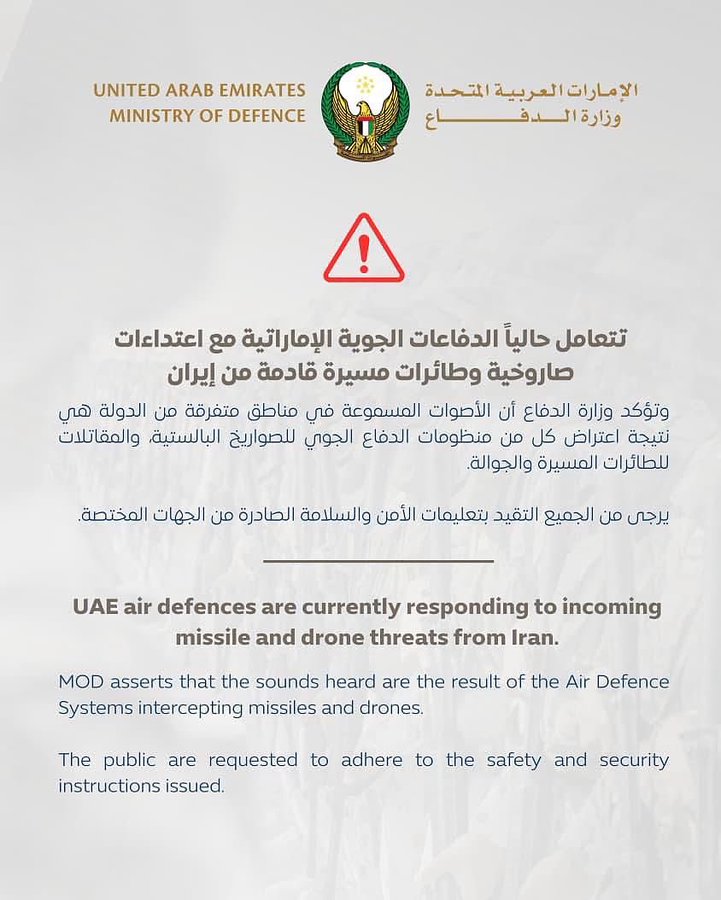
Abu Dhabi, UAE – Air defence systems across the United Arab Emirates are actively engaging and neutralizing missile and drone threats launched from Iran, the UAE Ministry of Defence (MOD) confirmed on Tuesday.
Residents across several emirates reported loud booms and explosions, which the MOD clarified were not direct strikes but the result of air defence systems intercepting incoming projectiles. “The sounds heard are due to the Air Defence Systems responding to and destroying missiles and drones,” the ministry stated.
READ MORE ARTICLES:
- Iran Allows Select Ships Safe Passage Through Strait of Hormuz
- Iran Intel Chief Esmail Khatib Killed
- UAE Air Defences Intercept Iranian Missile and Drone Threats
- Israel says it kills Iran security chief Larijani, Basij commander
- Federal Judge Halts U.S. Plan to Scale Back Childhood Vaccine Recommendations
- Deadly Spring Storm Wreaks Havoc Across Eastern U.S.
- Donald Trump’s Mystery Claim: Ex-President ‘Regrets Not Bombing Iran’—But No One Confirms the Call
- ROTC Students Stop ISIS-Linked Shooter at Old Dominion University
- Iran Names Google, Amazon, Microsoft as Possible Targets
- Iran–Philippines Ties to Become ‘Even Brighter,’ Says Ambassador
- Vladimir Putin Welcomes Mojtaba Khamenei as Iran’s New Leader
- Oil Prices Surge as Mojtaba Khamenei Takes Power Amid Middle East Tensions
- Tragedy at Sea: Remembering Todd Meadows of ‘Deadliest Catch’
- Iran’s Supreme Leader Ayatollah Ali Khamenei Dead
- Israel, US Strikes on Iran Fuel Middle East Crisis
The rapid response highlights the UAE’s advanced air defence capabilities and its readiness to protect its territory from potential regional threats. Authorities continue to monitor the situation closely, ensuring the safety of civilians while maintaining vigilance against further attacks.
No casualties or damages have been reported so far, and the MOD continues to assure the public that defensive measures are fully operational and effective.
Analysts note that the UAE’s interception efforts send a clear message of deterrence in the face of rising tensions in the region, emphasizing the nation’s strategic preparedness and security resilience.
UAE Faces Escalating Iran Attacks: Airports, Oil Hubs Hit Amid Airspace Closures
The United Arab Emirates is grappling with a sharp escalation in regional tensions as Iran launched multiple missile and drone strikes across the Gulf, prompting temporary closures of airspace, disruptions at major airports, and fires at critical oil and gas facilities.
The UAE’s General Civil Aviation Authority announced a full temporary closure of the country’s airspace on Monday, citing “an exceptional precautionary measure” as authorities scrambled to respond to the fast-moving security threats. Dubai International Airport, one of the world’s busiest hubs, temporarily suspended operations after a drone struck a fuel tank near the airport, triggering a fire. Civil defense teams quickly brought the blaze under control, and flights have gradually resumed, though some Emirates and foreign carrier flights remain canceled or diverted.
Meanwhile, Abu Dhabi authorities confirmed a missile strike hit a civilian vehicle in the Al Bahyah area, killing one Palestinian national. In Fujairah, a key oil-export port located outside the Strait of Hormuz, drone attacks triggered fires at petrochemical facilities, forcing a temporary halt to oil loadings at the terminal, which handles nearly 1 million barrels of Murban crude daily. ADNOC, the UAE state oil company, suspended operations as a precaution but later resumed partial loading.
The UAE Ministry of Defence said its air defence systems intercepted six ballistic missiles and 21 UAVs launched from Iran on March 16, bringing the total intercepted since the onset of hostilities to 304 ballistic missiles, 15 cruise missiles, and 1,627 drones. Despite these interceptions, at least 145 people across the region sustained injuries, including foreign nationals from India, Bangladesh, Pakistan, and other countries, highlighting the civilian toll amid the escalation.
Gulf Arab states, while not requesting direct U.S. military intervention, have urged Washington not to leave Iran capable of further threatening the region’s oil lifeline and economies, according to Gulf sources. U.S. President Donald Trump has sought regional backing for the military campaign, aiming to bolster international legitimacy and domestic support for the war.
The conflict has disrupted the global oil market. Brent crude rose above $104 per barrel on Monday, reflecting supply concerns as the Strait of Hormuz, a strategic chokepoint for nearly 20% of global oil exports, remains largely closed. Saudi Arabia has offered an alternative via the Red Sea port of Yanbu, though export capacity is limited, leaving global supply chains under strain.
Air travel and logistics have been heavily impacted. Indian nationals, one of the largest expatriate communities in the UAE, are particularly affected, with flights operated by Air India, Air India Express, and other carriers either diverted or canceled. Some 2,20,000 Indians have returned from the Gulf since the start of the conflict on February 28.
Authorities have also cracked down on the spread of misinformation, arresting 35 people in the UAE for sharing fabricated videos on social media, while Iran has detained hundreds for allegedly passing information to foreign entities.
Despite the chaos, UAE officials continue to stress measured responses. Anwar Gargash, diplomatic adviser to the UAE president, emphasized that while the country reserves the right to defend itself, it prioritizes reason, logic, and restraint.
The escalation follows a series of attacks across the region. Israel has launched strikes on Tehran and other Iranian cities in response to U.S.-Israeli operations. Iranian officials have warned they are prepared to escalate as needed, targeting U.S. and allied assets while striking civilian and industrial infrastructure across the Gulf.
Saudi Crown Prince Mohammed bin Salman and UAE President Sheikh Mohamed bin Zayed Al Nahyan have jointly condemned the attacks, underscoring the risk to regional security and stability.
As the conflict enters its third week, Gulf countries, energy markets, and civilian populations continue to navigate the fallout of unprecedented missile and drone assaults, with the UAE caught at the epicenter of one of the Middle East’s most volatile crises in recent history.
- Worst Country I’ve Visited- Thailand Girl, Stark Warning After Disappointing Vietnam Trip
- Artemis II | NASA, Voyage, Mission & Moon
- A Prayer of Thanksgiving for Divine Blessings, Triumph, Forgiveness, and Good Health
- NASA’s Artemis II Departs Earth Orbit for Historic Moon Flyby
- NASA: The Artemis Generation Takes Flight with Historic Artemis II Mission