Iranian state media has confirmed the death of Supreme Leader Ayatollah Ali Khamenei following a massive airstrike allegedly carried out by Israel and the United States, marking a dramatic turning point for the Islamic Republic and intensifying fears of a wider regional conflict.
VIEW PICTURE
Source: Pléiades Neo (c) Airbus DS 2026, Graphic by Phil Holm / FILE PHOTO VIEW PICTURE
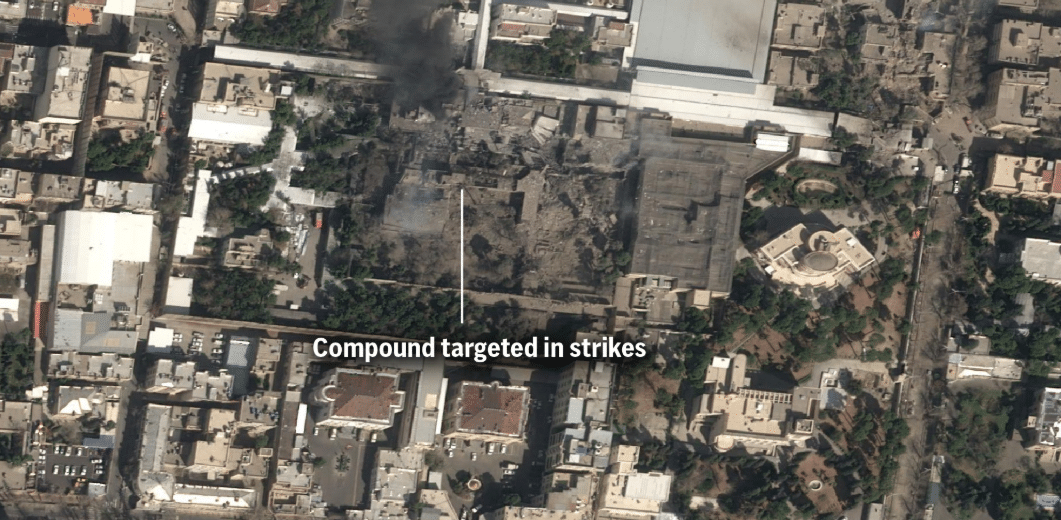
According to Iranian state television, the 86-year-old leader was killed early Sunday after an airstrike targeted his compound in downtown Tehran. Satellite imagery reportedly showed extensive damage to the area, with smoke rising across parts of the capital as multiple strikes were recorded nationwide.
U.S. President Donald Trump announced Khamenei’s death hours before the official confirmation, describing it as Iran’s “greatest chance” to reclaim its government. Trump defended the military action by accusing Iran of continuing to advance its nuclear and missile programs, including capabilities that could threaten the United States. However, the decision has sparked debate in Washington, with several members of Congress calling for a vote on a war powers resolution.
In response to the strikes, Iran launched missiles and drones toward Israel and U.S. military bases in the region, signaling immediate retaliation and heightening concerns about escalating hostilities. Iranian state media portrayed Khamenei’s death as occurring while he was “at the forefront of his responsibilities,” framing him as a leader who remained with his people until the end.
The killing of Iran’s long-serving Supreme Leader throws the country’s political future into uncertainty and raises the risk of broader instability across the Middle East.
READ MORE ARTICLES:
- Iran’s Supreme Leader Ayatollah Ali Khamenei Dead
- Karaniwang Modus sa MOOE: Paano Ninanakaw ang Pondo ng Paaralan at Paano Ito Masusugpo
- DepEd Rolls Out Strengthened SHS Curriculum Nationwide for SY 2026–2027
- Israel, US Strikes on Iran Fuel Middle East Crisis
- DepEd Announces Schedule of Bonuses and Allowances for Personnel 2026
On September 30, 2023, Iranian state media reported the death of Supreme Leader Ayatollah Ali Khamenei, a significant event that has sent shockwaves across Iran and the broader Middle Eastern geopolitical landscape. Khamenei had been at the helm of Iranian politics since 1989, overseeing vast political, social, and ideological transformations. His death marks the end of an era and raises critical questions about the future direction of Iran.
In the days following this announcement, Iran has experienced a wave of uncertainty and speculation regarding potential power vacuums and shifts in leadership dynamics. Khamenei’s death could trigger challenges to the legitimacy of the ruling elite, as well as impact Iran’s relationships with various regional players, including allies and adversaries alike. The immediate repercussions of his passing may extend beyond mere internal political strife, influencing Iran’s approach to key foreign policy areas and regional stability.
The broader implications of this pivotal moment are not to be overlooked, particularly concerning Iran’s role in ongoing conflicts and its place in regional alliances. For example, U.S.-Iran relations have been tense for years; any shifts in Iranian leadership could either exacerbate or mitigate these tensions. Additionally, Khamenei’s absence raises questions about the continuity of Iran’s support for proxy groups across the region, including in Syria, Lebanon, and Yemen. Such developments will be closely scrutinized not only by neighboring countries but also by global powers invested in Middle Eastern stability.
This introduction sets the stage for a deeper exploration of the impact of Ayatollah Khamenei’s death on Iran’s domestic landscape and its implications on regional geopolitics. As we delve further into these topics, a clear understanding of the consequences of this historical moment will become essential for grasping the future of both Iran and the Middle East.
Details of the Attack: What Happened?
On the morning of January 15, 2024, a precision airstrike took place in the vicinity of the Iranian capital, Tehran, leading to the death of Supreme Leader Ali Khamenei. This event marked a significant and unprecedented moment in Iran’s political landscape and raised concerns across the Middle East regarding stability and security. Intelligence sources have indicated that both the United States and Israel were involved in planning and executing this operation, which underscores the ongoing and complex geopolitical tensions in the region.
The attack occurred around 8:00 AM local time, targeting a military complex that had been known to host high-ranking officials, including Khamenei himself. The U.S. and Israel coordinated their efforts utilizing advanced satellite imagery and intelligence reports to confirm Khamenei’s presence in that particular location prior to the strike. The successful execution of the operation was attributed to the integration of sophisticated weaponry capable of delivering pinpoint strikes, thereby minimizing collateral damage.
Satellite imagery released shortly after the attack showed significant destruction at the site, with evidence of the airstrike’s impact visible from overhead views. Crater marks and damaged infrastructure corroborated reports of the strike’s effectiveness, validating claims made by both American and Israeli defense officials. Furthermore, eyewitness testimonies from nearby residents described a powerful explosion followed by multiple secondary detonations, suggesting the presence of munitions stockpiled at the complex.
The fallout from the attack has raised alarms not only within Iran but also among neighboring states, where leaders are now contemplating the implications of a potential power vacuum in the country. Protests erupted in various Iranian cities as news of Khamenei’s death spread, reflecting deep national sentiments amidst the uncertainty of Iran’s future direction.
Reactions from Iran: Government and Public
The death of Supreme Leader Ayatollah Ali Khamenei has elicited varied reactions from both the Iranian government and the public at large. Officially, the Iranian government expressed deep sorrow and positioned Khamenei’s demise as a significant loss for the nation. State media quickly disseminated messages of condolences, highlighting his leadership and contributions to the Islamic Republic since its establishment. President Ebrahim Raisi acknowledged Khamenei’s pivotal role in guiding Iran through numerous challenges and urged the people to maintain unity in this period of mourning.
As a reaction to his passing, the government initiated public mourning ceremonies, which are tradition in Iran following the loss of a prominent figure. Several state-sponsored events have been organized to honor Khamenei’s legacy, where images and video tributes to Khamenei have been prominently displayed. The government is keenly aware of the consequences his death might have on national stability, especially given the current socio-economic issues. Hence, they aim to channel public sentiment towards continuity and resilience.
In contrast, the public reaction appears to vary significantly across different demographics. While some segments express genuine grief over the loss of a leader, others show skepticism regarding the future direction of the Iranian regime without Khamenei’s guidance. This skepticism is particularly palpable among youth and reformist groups who have voiced a longing for change. Furthermore, social media platforms have become venues for varied opinions, where some take to mourning while others express hopes for reform and progressive change in the political landscape.
This discord in reactions reflects a broader sentiment among Iranians who are contemplating the future. The loss of Khamenei may prove to be a pivotal moment for national morale, one that could either cement government authority or fuel calls for democratization, depending on how the government navigates this transitional phase.
Donald Trump’s Statement: An Appeal to the Iranian People
In the wake of Ayatollah Ali Khamenei’s death, former U.S. President Donald Trump made a notable statement that aimed to resonate with the Iranian populace. In his address, Trump expressed his hopes for the Iranian people to “take over” their government, which can be interpreted as both a call for political change and a critique of the current Iranian regime. This statement reflects a significant shift in the narrative surrounding U.S.-Iran relations, particularly in the context of the evolving geopolitical landscape.
Trump’s appeal is significant as it attempts to engage directly with the Iranian people, encouraging them to assert their desires for freedom and democracy. This rhetoric aligns with a broader trend observed in U.S. foreign policy, especially during Trump’s presidency, characterized by a focus on promoting democratic values in authoritarian regimes. The former president’s approach places emphasis not only on the Iranian leadership but also on the potential agency of its citizens, suggesting that change may stem from within.
Additionally, this statement has considerable political implications. It raises questions about the U.S. stance regarding interventionism and support for popular uprisings in authoritarian contexts. While calling for Iranian citizens to initiate a change in government, there is a risk of alienating those who fear foreign involvement in their nation’s affairs. However, Trump’s angle may be seen as aligning with a segment of the Iranian populace that yearns for reform and greater democratic governance.
Ultimately, the response from the Iranian people and their leaders to Trump’s statement will be crucial in shaping the future dynamics of U.S.-Iran relations. It remains to be seen whether this call will embolden any movements within Iran or be interpreted as an outsider’s interference in domestic politics. The ramifications of such statements are profound, influencing not only political discourse within Iran but also the complex web of international relations in the region.
Immediate Retaliation: Iran’s Response to the Strikes
Following the death of Supreme Leader Ayatollah Ali Khamenei, Iran’s government articulated a sense of urgency and necessity in demonstrating its military capacity. The nation swiftly organized a series of missile and drone strikes targeting U.S. military bases in the region and Israel as a direct response to perceived aggressions, thereby highlighting the importance of deterrence in Iranian military strategy. These actions illustrated not only a vengeance for the loss of a key leader but also a reinforcement of Iran’s geopolitical stance in the Middle East.
Strategically, the retaliatory strikes were significant for several reasons. Firstly, Iran aimed to assert its deterrent capabilities, reaffirming its role as a dominant player in regional politics. The choice to employ drones – known for their precision and lower cost compared to traditional aerial assaults – underlined Iran’s adaptation of modern warfare tactics while also showcasing its technological advancements. These actions served as a blatant warning to the U.S. and its allies about the consequences of continuing military interventions in Iranian spheres of influence.
Additionally, the strikes had wider implications for Iran’s relationships within the region. By engaging in military action, Iran sought to provide a rallying point for allied groups and factions such as Hezbollah and various Shiite militias across the Middle East. This was not merely an act of revenge but a strategic move to reinforce collective resistance against foreign influences and interventions, thereby solidifying Iran’s regional ties further.
Ultimately, Iran’s immediate military response to Khamenei’s death can be seen as both a defense of sovereignty and an attempt to navigate the complex geopolitical landscape characterized by ongoing hostilities. Through these actions, Tehran aimed to project strength to both domestic audiences and international actors, framing its military capabilities as realized instruments of power in the face of adversaries.
Implications for Iran’s Future Leadership and Governance
The death of Supreme Leader Ayatollah Ali Khamenei marks a pivotal moment for Iran, one that could lead to significant shifts in the political landscape both domestically and within the broader Middle Eastern region. The leadership transition will likely hinge on the dynamics within the ruling elite and the various factions that constitute the Iranian political framework. Khamenei’s leadership style, characterized by a consolidation of power within the hands of a few, may influence how his successor approaches governance.
Several potential successors have emerged, each embodying different ideologies and political strategies. Among them is Ebrahim Raisi, the current President of Iran, who is viewed as a close ally to Khamenei. If Raisi ascends to the role of Supreme Leader, one could expect a governance model that continues the strict adherence to Khamenei’s policies, focusing on resistance to Western influence and an emphasis on the Islamic Republic’s foundational principles. Conversely, other figures such as former parliamentary speaker Ali Larijani or Mohsen Rezaei may advocate for a more pragmatic, reform-driven approach, potentially leading to subtle shifts in foreign policy that prioritize diplomatic engagement over confrontation.
The successor’s approach to governance will also be determined by the socio-economic challenges facing Iran, including sanctions, economic mismanagement, and public discontent. A successor who prioritizes dialogue with the international community could ease tensions and possibly rejuvenate Iran’s economy, while a more hardline figure might further entrench isolationist policies, adversely affecting Iran’s global standing. The interplay among the competing political factions and how they influence the selection of a successor will significantly impact Iran’s strategic direction.
As Iran stands at this crossroads, the implications of Khamenei’s death cannot be understated. The choice of new leadership will not only shape domestic governance but also redefine Iran’s role and relationships within the turbulent geopolitical landscape of the Middle East.
Regional Instability: Risks Ahead
The death of Supreme Leader Ayatollah Ali Khamenei marks a pivotal juncture for Iran and the wider Middle East, creating a significant power vacuum that could lead to heightened instability in the region. Khamenei’s leadership was characterized by a rigid control over Iran’s political and ideological landscape; his absence can erode the existing balance of power among various factions within the Iranian government as well as among regional actors.
Historically, Iran has been a crucial player in Middle Eastern geopolitics, often engaging in proxy conflicts and exerting influence through various militant groups across the region. With Khamenei’s death, there is a potential for internal disagreements among Iranian leadership factions, particularly between reformists and hardliners, which could hinder the country’s foreign policy continuity. Such discord may embolden regional adversaries, including Saudi Arabia and Israel, prompting them to escalate their military postures.
Furthermore, the implications extend beyond Iran’s borders; neighboring countries that share a fraught relationship with Tehran may attempt to exploit the uncertainty. Nations such as Iraq, Syria, and Lebanon, where Iranian influence is pronounced, could experience an uptick in sectarian tensions as rival groups vie for power and legitimacy in the absence of a clear central authority from Iran.
The risk of escalating conflict is compounded by the historical precedent of power vacuums in the region leading to prolonged instability. The aftermath of the Arab Spring is a stark reminder of how quickly power shifts can spiral into broader conflicts. Additionally, the involvement of external powers, each with divergent interests, adds complexity to the situation. Should tensions rise further, the potential for military confrontation could increase dramatically, irrevocably shifting the balance of power in the Middle East.
Responses from Global Leaders
The death of Supreme Leader Ayatollah Ali Khamenei has sent ripples through the international community, eliciting a variety of responses from world leaders and organizations. Governments around the globe have expressed their condolences, while analyzing the potential implications for Iran and the broader region. The tone of these responses has ranged from sympathetic to cautious, reflecting the complex dynamics at play.
Leaders from Western nations, particularly the United States and European countries, have emphasized the need for vigilance, expressing concerns regarding the potential for unrest within Iran. They recognize that Khamenei’s death could lead to a power vacuum, heightening the possibility of internal strife or a shift in the existing political landscape. For example, the United States Secretary of State released a statement urging for a peaceful transition and emphasizing the importance of respecting human rights in the aftermath of this significant change.
On the other hand, regional powers such as Saudi Arabia and Israel have viewed Khamenei’s passing as an opportunity for potential shifts in policy and strategy. Health assessments from high-ranking officials in these countries indicate a cautious optimism about re-evaluating diplomatic relations with Iran should a more moderate leadership emerge. However, they remain alert to the risk of an escalation in aggressive stances from hardline factions seeking to assert control during this transitional period.
Furthermore, organizations like the United Nations have called for stability and restraint, urging all parties to engage in dialogue to prevent violence. The global body highlights the significance of maintaining peace for the region, as the implications of Khamenei’s death extend beyond Iran’s borders.
In conclusion, the responses from global leaders reflect a mixture of sympathy, caution, and strategic recalibration. As the international community assesses the situation, the ramifications of Khamenei’s death will undoubtedly shape diplomatic dialogues moving forward, forcing a reevaluation of policies toward Iran and the surrounding region.
A Turning Point for Iran and Beyond
The death of Supreme Leader Ayatollah Ali Khamenei marks a significant turning point not only for Iran but also for the broader geopolitical landscape of the Middle East and beyond. Khamenei’s long-standing leadership style, characterized by a firm grip on power and an unwavering commitment to the principles of the Islamic Revolution, has shaped Iran’s domestic and foreign policies for decades. His passing prompts a critical examination of what lies ahead for the nation and the potential shifts in regional stability.
The immediate impact is likely to be felt within Iran’s political sphere as various factions vie for control in the ensuing power vacuum. This struggle could lead to a period of uncertainty and instability, with implications for Iran’s governance and its ability to project power regionally. The potential for increased dissent domestically may also challenge the current regime, as citizens respond to the uncertainty surrounding succession and the future direction of the country.
Regionally, Khamenei’s death could alter the balance of power among neighboring countries. For instance, rival nations that have long navigated a tense relationship with Tehran, such as Saudi Arabia and Israel, may reassess their strategies in light of Iran’s potential changes in leadership. Moreover, Iran’s role in proxy conflicts across Syria, Lebanon, and Yemen may evolve, prompting shifts in allegiances and strategies among both allies and adversaries.
In the global context, the international community will be closely monitoring the developments in Iran following Khamenei’s death. Diplomatic engagements surrounding nuclear negotiations and sanctions may alter, affecting long-standing relationships with major powers like the United States and European nations. The interplay of domestic power struggles with global diplomatic efforts points to a pivotal moment in Iran’s history, one that could usher in profound transformations for both the nation and the region as a whole.