The International Criminal Court in The Hague, former Philippine President Rodrigo Duterte’s defense team argued that prosecutors have failed to directly link his public statements to the thousands of deaths under investigation. Lead counsel Nicholas Kaufman dismissed the prosecution’s case as built on “cherry-picked” rhetoric, insisting there’s no concrete evidence tying Duterte to specific killings, casting doubt on whether the case will proceed to a full trial.
VIEW PICTURE
In The Hague on February 23, 2026, supporters of former Philippine President Rodrigo Duterte demonstrated outside the International Criminal Court (ICC), where he faced questioning on alleged crimes against humanity. The demonstrators displayed a banner asserting Philippine sovereignty and featured a life-size cardboard cutout of Duterte. The event was documented by Agence France-Presse. VIEW PICTURE
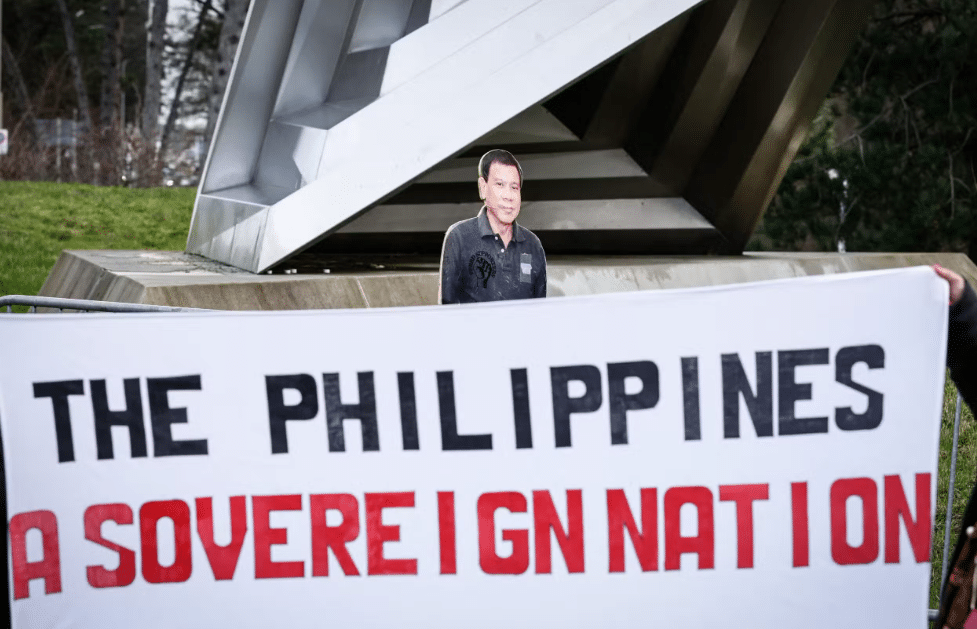
THE HAGUE, Netherlands — In a fiery defense that spanned several hours, former Philippine president Rodrigo Duterte‘s lead counsel told the International Criminal Court on Thursday that prosecutors have failed to establish any direct link between his client’s “uniquely colourful and crusty” public speeches and the thousands of deaths at the heart of the crimes against humanity case against him .
British-Israeli lawyer Nicholas Kaufman delivered what legal observers described as a pointed and methodical rebuttal on the third day of confirmation of charges hearings, arguing the prosecution’s case rests on “cherry-picked” rhetoric rather than concrete evidence tying Duterte to specific killings.
READ MORE ARTICLES:
- Donald Trump State of the Union Focuses on Jobs, Borders and Foreign Policy
- Kimberly Pagong: Duterte’s War on Drugs — Saving Millions or Misunderstood Leadership?
- Philippines Celebrates 40th Anniversary of EDSA People Power
- Missing of Nancy Guthrie
- DepEd Heroes: Teacher Jeric Maribao Honored for Exceptional Dedication and Innovation
- China, Ukraine Reaffirm Strategic Ties, Push for Peace at Munich Security Conference
“There is no smoking gun in this case,” Kaufman told the three-judge panel of Pre-Trial Chamber I. “Not one witness relevant to any of the 49 incidents with which Mr. Rodrigo Duterte is charged will testify that he received a direct order from the former president to go out and kill someone” .
The 80-year-old former leader, who was arrested and transferred to The Hague in March 2025, has waived his right to appear at the hearings. Kaufman told the court his client is not mentally fit to follow the proceedings, though he described Duterte’s spirits as “good” during daily visits at the ICC detention center in Scheveningen .
At the heart of Kaufman’s argument is what he termed the absence of a “causal nexus” between Duterte’s words and the alleged crimes a legal principle requiring prosecutors to prove a direct connection between a defendant’s actions and the harm suffered.
Citing previous ICC jurisprudence, including the 2018 Katanga case where Trial Chamber II dismissed reparations claims due to insufficient causal link, Kaufman emphasized that the prosecution must meet a high evidentiary threshold at this stage .
The defense counsel accused prosecutors of selectively editing Duterte’s public addresses to paint him as orchestrating mass murder, while ignoring dozens of instances where he explicitly instructed police to operate within legal boundaries.
“Ten of these speeches, including two referred to by the deputy prosecutor, actually contained an exaltation to the use of lawful self-defense,” Kaufman said, pointing to Duterte’s repeated instruction “Do not kill if you are not in danger of losing your life” .
Kaufman framed the former president’s approach as rooted in what he called the “exaltation of the principle of lawful use of self-defense” a doctrine he argued applies to law enforcement facing violent resistance from armed drug suspects .
International law expert Ross Tugade, analyzing the defense strategy for Rappler, noted that Kaufman appeared focused on establishing Duterte’s intent to pursue lawful means. However, Tugade pointed out that the Rome Statute “doesn’t require a legal evaluation on the part of the perpetrator”—meaning Duterte’s subjective belief in self-defense may not shield him from liability if his actions foreseeably led to widespread unlawful killings .
Prosecution case, a ‘systematic attack’ on civilians
Earlier this week, prosecutors laid out their case against the former president, alleging he played a “pivotal” role in a campaign of extrajudicial killings that left thousands dead during his tenure as Davao City mayor and later as president from 2016 to 2022.
ICC prosecutors presented multiple videos of Duterte threatening to kill drug suspects and boasting about his role in past killings. They alleged he personally drew up death lists and created an environment of impunity where police and vigilantes alike understood that killing drug suspects would carry no consequences.
Paolina Massidda, principal counsel for the Office of Public Counsel for Victims, painted a stark picture of what she called a “systematic attack” on the civilian population.
“Late night raids, forced entry without warrants, victims shot at close range, similar post-incidence police reports, consistent narrative of armed resistance, ‘nanlaban’ (they fought back), planting of drugs and weapons, and the absence of genuine investigation demonstrate a systematic attack,” Massidda told the court on Tuesday .
“The pattern is not a coincidence. It is structured,” she added.
Massidda argued that it mattered little whether perpetrators were police officers or vigilantes, noting that “the similar tactics used show planning and coordination involving law enforcement authorities, and, at times, local officials” .
Filipino lawyer Gilbert Andres, also representing victims, described the human toll in visceral terms, telling the court that victims and their families were left feeling stripped of their dignity”inalisan kami ng dangal,” as one victim told him .
“The victims were mostly low-income, from high-density communities, 69,000 persons per square kilometer, with a typical area of residence about six square meters,” Andres said, gesturing to two tables behind him to illustrate the cramped living spaces where many killings occurred. “It was a war against the poor”.
Official police records show approximately 6,200 deaths in anti-drug operations during Duterte’s presidency, though human rights organizations estimate the true toll, including vigilante-style killings, could reach 30,000 .
The ‘nanlaban’ defense and command responsibility
Kaufman sought to distinguish between lawful police operations and the killings now at issue, arguing that Duterte’s directives to police emphasized restraint.
Citing testimony from Senator Ronald “Bato” Dela Rosa who served as Duterte’s national police chief and later as Philippine National Police chief Kaufman noted that Dela Rosa’s stated goal was to “instill fear in the heart of drug addicts,” which he described as “anything but criminal” and supportive of the defense’s theory that force was only authorized in self-defense scenarios .
The defense argument faces significant legal hurdles. Under the doctrine of command responsibility, superiors can be held liable for crimes committed by subordinates if they knew or should have known about them and failed to prevent or punish them.
Massidda emphasized this point, telling the court that “there is no evidence that (Duterte) took any steps to prevent or punish those responsible for the murders” .
The prosecution has presented what it says are 181 pieces of evidence supporting its case, though Vice President Sara Duterte, the former president’s daughter, has publicly questioned the strength of this evidence.
“We have 181 pieces of evidence and we don’t even have 50 victims. This is 43 counts of murder, not even 50. So, where is the system there of killing thousands?” she said in March 2025 interviews, adding a pointed critique of the prosecution’s legal team .
ICC spokesman Fadi El Abdallah has explained that the 43 counts in the arrest warrant serve as a “sample” and do not represent the final number of charges should the case proceed to trial .
Jurisdiction fight looms
Beyond the factual disputes over Duterte’s speeches and their consequences, Kaufman has signaled an aggressive challenge to the ICC’s very authority to hear the case.
The Philippines withdrew from the Rome Statute in 2019, and Kaufman has argued this deprives the court of jurisdiction a position he described to reporters as a “compelling” argument that should stop the case before trial .
“I think that the jurisdictional argument is compelling as defense counsel. I believe that it should succeed and I would be hugely disappointed if it doesn’t succeed,” Kaufman told AFP in March .
However, the ICC’s arrest warrant, signed by Presiding Judge Iulia Antoanella Motoc and two other judges, explicitly addressed this issue, finding that crimes alleged to have occurred between November 1, 2011, and March 16, 2019 when the Philippines was still an ICC member—”fall within the jurisdiction of the Court” .
Legal analysts at Just Security have argued that the plain text of the Rome Statute supports the court’s jurisdiction, noting that Article 127 states withdrawal shall not “prejudice in any way the continued consideration of any matter which was already under consideration by the Court prior to the date on which the withdrawal became effective” .
Kaufman has also attacked the circumstances of Duterte’s arrest, characterizing his March 2025 transfer to The Hague as “a kidnapping, nothing more or less” and “an extrajudicial rendition” that violated Philippine law .
“This was in complete contravention of Philippines law,” he said, alleging the arrest represented a “political hit job” amid deteriorating relations between the Duterte and Marcos political families .
‘Hearsay upon hearsay’: Duterte defense tears into prosecution witness credibility at ICC
In a blistering attack on the foundation of the prosecution’s case, former Philippine president Rodrigo Duterte’s defense counsel told the International Criminal Court on Thursday that the witnesses against him are “inherently unreliable” — self-confessed murderers trading testimony for immunity in what he called a morally repugnant bargain to “nail” his client.
British-Israeli lawyer Nicholas Kaufman, continuing his methodical dismantling of the prosecution’s case on the third day of confirmation of charges hearings, urged the three-judge panel to assign “negligible evidentiary weight” to witnesses whose statements he characterized as “assumption layered upon hearsay.”
The prosecution’s witnesses are “inherently unreliable because (they are) self-confessed vicious murderers testifying in return for virtual immunity from proceedings at the ICC,” Kaufman told Pre-Trial Chamber I.
He argued there was “something morally repugnant or even questionable from a public policy standpoint to shield not only one but a number of murderers from prosecution at the ICC just in an attempt to nail Rodrigo Duterte.”
The sharp rebuke came on the final day of a week-long confirmation of hearings that will determine whether the 80-year-old former Philippine leader faces trial on crimes against humanity charges over his bloody “war on drugs” that left thousands dead.
Kaufman systematically attacked the credibility of the prosecution’s witness pool, arguing that relying on the testimony of confessed killers created an inherent conflict that should give any reasonable court pause.
Beyond the moral questions, the defense lawyer alleged that witness statements contradicted each other on multiple key points—further undermining what he described as an already shaky evidentiary foundation.
He dismissed their accounts as “assumption layered upon hearsay” and pressed the judges to effectively disregard them when weighing whether sufficient evidence exists to send Duterte to trial.
The argument strikes at the heart of the prosecution’s strategy. Earlier in the week, ICC prosecutors had laid out their case that Duterte played a “pivotal” role in orchestrating extrajudicial killings, presenting videos of the former president threatening drug suspects and alleging he personally drew up death lists.
But without direct testimony linking Duterte to specific murder orders—what Kaufman has repeatedly called the absence of a “smoking gun”—the prosecution has relied heavily on circumstantial evidence and the accounts of those who carried out the killings.
‘The last refuge’
The defense’s scorched-earth approach to witness credibility did not go unanswered. Earlier in the week, Gilbert Andres, a Filipino lawyer representing victims, delivered an emotional submission to the court, telling judges that the ICC represented the “last refuge” for families seeking justice for loved ones killed in the anti-drug campaign.
Andres described the human toll in visceral terms, recounting how victims and their families were left feeling stripped of their dignity “inalisan kami ng dangal,” as one survivor told him.
The victims, he said, came predominantly from Manila’s poorest communities, crowded into spaces of just six square meters where police raids and vigilante killings became a terrifying fact of life.
“It was a war against the poor,” Andres told the court.
Official police records show approximately 6,200 deaths during Duterte’s 2016-2022 presidency, though human rights organizations estimate the true toll, including vigilante-style killings, could reach 30,000.
Kaufman’s careful distinction
Despite his aggressive attacks on the prosecution’s witnesses, Kaufman was careful to strike what he framed as a respectful tone toward the dead and their families.
“The defence does not disrespect the soul of any deceased person, nor does it make light of the loss of life,” he stressed to the court.
The distinction is a delicate one. The defense strategy requires acknowledging the reality of deaths during Duterte’s war on drugs while contesting the former president’s legal responsibility for them.
Kaufman has argued throughout the week that prosecutors have failed to establish the necessary “causal nexus” between Duterte’s speeches and the killings a legal principle requiring direct connection between a defendant’s actions and alleged crimes.
Broader defense arguments
The credibility attack comes alongside broader defense challenges to the ICC’s jurisdiction and what Kaufman has characterized as “cherry-picked” evidence.
Earlier in the week, he argued that prosecutors had selectively edited Duterte’s public addresses while ignoring dozens of instances where he explicitly instructed police to operate within legal boundaries, including telling officers: “Do not kill if you are not in danger of losing your life.”
Kaufman has also signaled an aggressive challenge to the ICC’s authority to hear the case at all. The Philippines withdrew from the Rome Statute in 2019, though the court’s arrest warrant asserts jurisdiction over crimes alleged between November 2011 and March 2019, when the Philippines was still a member.
Following the conclusion of the week-long confirmation of charges hearing, the three-judge panel has 60 days to decide whether to proceed to a full trial.
The standard at this stage is not proof beyond a reasonable doubt, but rather whether there are “substantial grounds to believe” Duterte committed the crimes charged.
Legal observers note that the prosecution need not present its full case at this stage, but must demonstrate sufficient evidence that the charges should proceed to trial.
For victims’ families who have followed the proceedings from The Hague and the Philippines, the stakes are existential. Andres told the court they see the ICC as their last hope for acknowledgment of their suffering.
For Duterte, who has waived his right to appear at the hearings and whose counsel says is not mentally fit to follow proceedings, the decision will determine whether the 80-year-old former leader faces a full trial that could last years.
The defense, meanwhile, has made clear it believes the case should end here. Kaufman has expressed concern that the court might be reluctant to dismiss such a high-profile matter, telling reporters he fears the ICC is “starved of cases at the present moment and might be loath to let a case like that go.”
If confirmed for trial, the case would proceed to what promises to be a landmark proceeding—one that will test not only the evidence against Duterte but the very boundaries of international criminal law and its application to a leader who remains deeply polarizing in his home country.
The confirmation of charges hearing, which began February 23, is scheduled to continue with the prosecution given an opportunity to respond to Kaufman’s arguments. The three judges must then decide whether sufficient evidence exists to send the case to full trial .
Legal observers note that the standard at this stage is not proof beyond a reasonable doubt, but rather whether there are “substantial grounds to believe” Duterte committed the crimes charged.
Kaufman, whose previous ICC clients include former Congolese rebel leader Jean-Pierre Bemba, expressed concern that the court might be reluctant to dismiss such a high-profile case.
“My only fear is that this court is starved of cases at the present moment and might be loath to let a case like that go, to slip through its hands,” he said .
For the families of victims, many of whom have traveled to The Hague to follow the proceedings, the stakes could not be higher. Andres told the court in his emotional submission that victims see the ICC as their last hope for acknowledgment of their suffering .
The Pre-Trial Chamber’s decision on whether to confirm the charges is expected in the coming months. If confirmed, the case would proceed.