Clarita Reyes Carlos (born June 24, 1946) is a Filipino political scientist, academic, educator, and public commentator. She most recently served as National Security Adviser during the administration of Ferdinand Marcos Jr. from 2022 to 2023. In that role, she also held concurrent positions as Director-General of the National Security Council and Vice Chairperson of the Anti-Terrorism Council. (VIEW PICTURE)
From 1998 to 2001, she was the 16th President of the National Defense College of the Philippines, making history as the first woman and the first civilian to head the institution.
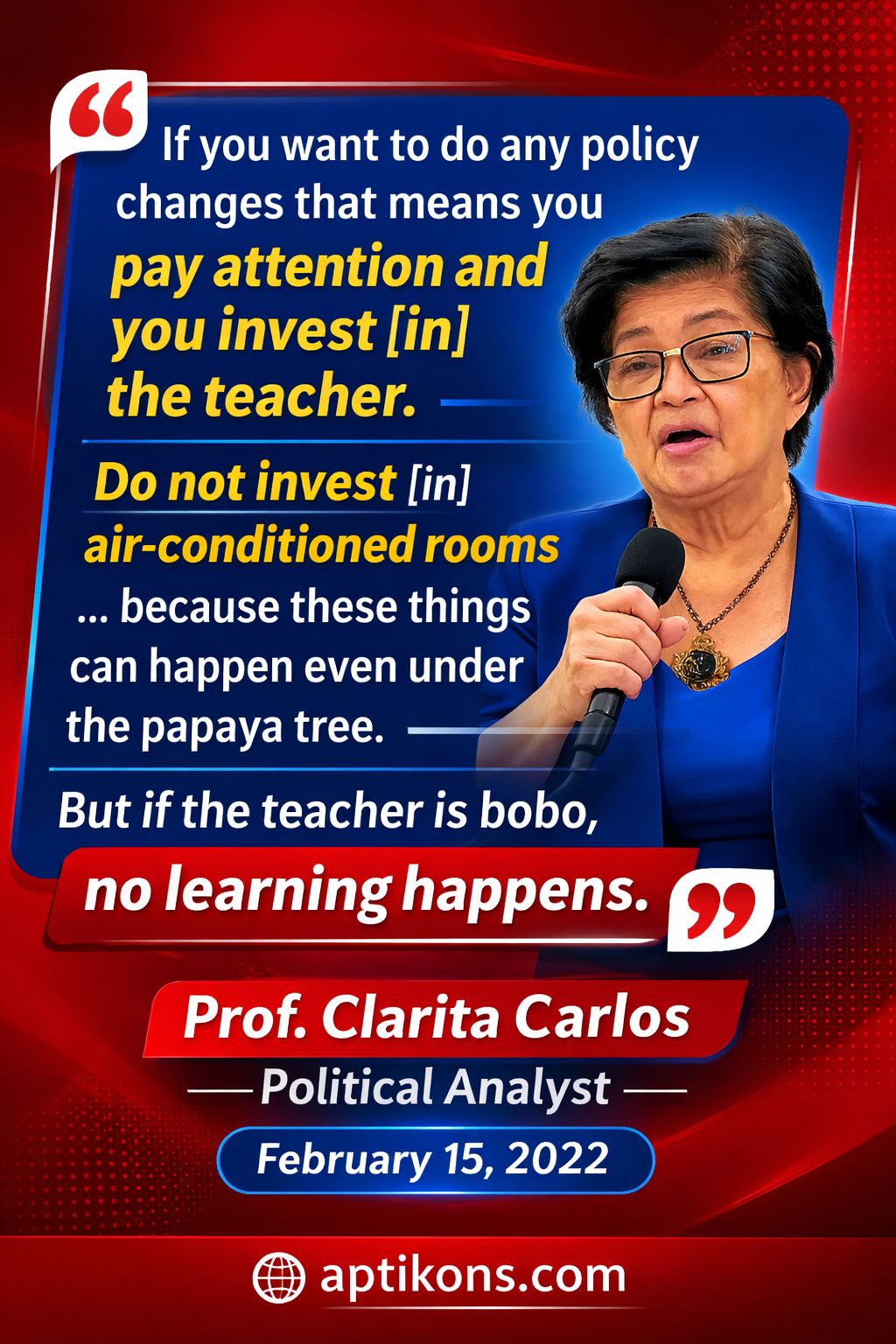
READ: Clarita Carlos—Kahit naka-aircon pa classroom kung bobo ang guro, wala din learning mga bata!
Carlos is a retired professor of political science at the University of the Philippines Diliman. She earned her Bachelor of Science, Master of Arts, and Doctor of Philosophy degrees from the same university.
Her doctoral dissertation, completed in 1982, was titled “Motives of Public Officials at a Distance: A Case Study of Two Philippine Presidents (President Ramon Magsaysay and President Ferdinand Marcos).”
The Life and Legacy of Clarita Reyes Carlos: A Pioneering Filipino Political Scientist
Clarita Reyes Carlos is a prominent figure in the realm of political science in the Philippines, renowned for her extensive contributions as an educator, political scientist, and government official. Her career is characterized by a dedication to advancing political thought and practice in the country. Carlos’s academic tenure is distinguished by her role as a professor at the University of the Philippines, where she has influenced generations of students and scholars through her teachings on international relations, security studies, and governance.
Her most recent appointment as the National Security Adviser under President Bongbong Marcos has further solidified her status as a leading voice in the field of political science in contemporary Filipino politics. In this capacity, she has been tasked with the critical responsibility of advising the government on national security issues, which includes an array of challenges ranging from regional stability to contemporary security threats. Carlos’s expertise in political dynamics is crucial in navigating these complexities while fostering a more secure Filipino society.
Thw legacy of Clarita Reyes Carlos, exploring the pivotal roles she has played in shaping Philippine politics. It will examine her academic contributions, her various governmental roles, and the impact of her work on national and international discourse. Key themes will include her advocacy for academic integrity and research rigor, her insights into national security frameworks, and her influence on policy formation in the Philippines. Through this exploration, we aim to appreciate not only her contributions to the field of political science but also the broader implications of her work for the Philippine socio-political landscape.
Early Life and Education
Clarita Reyes Carlos was born into a Filipino family that valued education and intellectual pursuit. Her early years were spent in a nurturing environment, where the foundations of her keen intellect and passion for learning were established. Carlos attended Bonifacio Memorial Elementary School, where she displayed an early aptitude for academic excellence. This primary education laid the groundwork for her subsequent academic achievements.
Following her time at elementary school, Carlos continued her education at La Consolacion College, a prestigious institution known for its academic rigor and commitment to forming well-rounded individuals. Here, she further honed her analytical skills and developed a keen interest in the social sciences. The combination of her formative education and the emphasis on critical thinking at La Consolacion College significantly influenced her trajectory towards becoming a political scientist.
Further demonstrating her commitment to education, Carlos pursued higher studies at the University of the Philippines Diliman, one of the leading universities in the Philippines. She completed her Bachelor’s degree in political science, where she delved into various political theories and systems, enriching her understanding of governance and public policy. Her academic excellence earned her a scholarship, allowing her to progress into her Master’s program and eventually her Doctorate in political science.
The focus of her doctoral dissertation was particularly noteworthy; she investigated the intricacies of Filipino politics through a nuanced lens. This comprehensive study not only highlighted the dynamics of Philippine governance but also showcased her ability to tackle complex issues through rigorous research methodologies. With her extensive education and deep understanding of political science, Carlos emerged as a prominent figure in her field, laying the groundwork for a prolific career dedicated to public service and academic contributions.
Academic Career and Contributions
Clarita Reyes Carlos embarked on her academic journey in 1967 at the University of the Philippines Diliman, where she devoted several decades to the field of political science. Her teaching career was marked by a commitment to educating the next generation of scholars and leaders, where she not only served as a professor but also held multiple significant professorial chairs that underscored her expertise and influence. Throughout her tenure, she was noted for her engaging teaching style that inspired countless students to delve into political theory and practice.
In addition to her foundational role at the University of the Philippines, Carlos expanded her teaching horizons to include positions at distinguished institutions such as Ateneo de Manila University and San Beda University. This allowed her to reach and impact diverse student populations, fostering an appreciation for political science across different academic cultures. Her versatility as an educator helped bridge theoretical concepts with real-world applications, ensuring that her students were not only well-versed in political theory but also prepared for the complexities of the modern political landscape.
Carlos’s academic contributions extended beyond the classroom. She authored several influential texts and scholarly articles that enhanced the understanding of Philippine politics and international relations. Her research often explored critical issues such as democratic governance, political participation, and the role of women in politics, which were pivotal during her time. Through rigorous analysis and thought leadership, she became a prominent voice in the academic community, contributing to seminars, conferences, and policy discussions that sought to inform and influence public policy.
Overall, Clarita Reyes Carlos’s academic career represents a significant chapter in the history of political science in the Philippines. Her legacy as a pioneering educator and thinker continues to inspire future generations of scholars and practitioners in the field.
Leadership at the National Defense College of the Philippines
Clarita Reyes Carlos made history by becoming the first female and civilian president of the National Defense College of the Philippines (NDCP) from 1998 to 2001. Her appointment was a remarkable milestone in a predominantly male-dominated institution, setting a precedent for gender equality in the field of national defense and strategic studies. During her tenure, Carlos played a pivotal role in reshaping the college’s approach to education and institutional governance.
One of her notable contributions was the implementation of significant organizational improvements that enhanced the NDCP’s academic and administrative efficiency. Carlos emphasized the importance of modernizing the curriculum to include contemporary issues in global security and defense strategies. Her leadership fostered an innovative environment that encouraged critical thinking and engagement in the evolving landscape of international relations.
Additionally, Carlos initiated the establishment of the Strategic Studies Group, which aimed to enhance the analytical capabilities of the college and facilitate research on pressing national and regional security concerns. This group became instrumental in cultivating a rigorous academic atmosphere where students and faculty could explore strategic challenges and collaborate on solutions. By bridging the gap between theory and practical application, the Strategic Studies Group equipped the next generation of leaders with the tools necessary to address complex geopolitical issues.
Moreover, Carlos’s leadership style was characterized by her inclusive approach, encouraging collaboration and open dialogue among faculty, staff, and students. Her commitment to fostering a supportive and diverse educational environment resonated throughout the institution and inspired many. Overall, Clarita Reyes Carlos’s tenure at NDCP not only contributed to its institutional growth but also left an indelible mark on the future of political science education in the Philippines.
Roles in Government and Public Policy
Clarita Reyes Carlos has had a significant impact on government and public policy in the Philippines through her various roles in key governmental institutions. One of her notable positions was with the Metropolitan Manila Development Authority (MMDA), where she contributed to urban planning and public administration initiatives aimed at improving the quality of life in the National Capital Region. During her tenure, she was instrumental in developing policies that addressed pressing urban issues such as traffic congestion, waste management, and disaster preparedness, which are critical for sustainable urban living.
Her work at the MMDA highlighted her commitment to enhancing metropolitan governance, showcasing her ability to blend academic insights with practical applications. This intersection of theory and practice is a hallmark of her career as a political scientist, and it paved the way for her subsequent appointment to the Commission on Higher Education (CHED). At CHED, Carlos focused on advancing academic standards across the country’s higher education institutions. She championed reforms that emphasized not only the enhancement of academic programs but also the importance of research and public engagement in higher education.
Through her leadership roles, Carlos advocated for the integration of innovative practices in both urban management and educational policies, illustrating her dedication to fostering an informed citizenry. Her strategies for developing human resources through higher education reform directly contributed to the cultivation of a skilled workforce capable of addressing the complexities of modern society. By aligning educational outcomes with the national development agenda, Carlos helped elevate academic standards, thus positively influencing public policy and governance in the Philippines.
Tenure as National Security Adviser
Clarita Reyes Carlos served a notable tenure as the National Security Adviser of the Philippines, a role that thrust her into the complexities of the nation’s security landscape. Appointed to this significant position, she became an influential figure, particularly regarding issues surrounding national security and counter-terrorism. Her involvement extended further as she also took on the responsibilities of vice chairperson of the Anti-Terrorism Council, a body tasked with shaping the Philippines’ counter-terrorism strategies.
Throughout her term, Carlos maintained a staunch opposition to the practice of “red-tagging,” which refers to the labeling of individuals or groups as communists or terrorists without substantial evidence. This controversial tactic has often been criticized for leading to violence and repression against activists, dissenters, and various civil society organizations. Carlos emphasized the importance of ensuring that national security measures did not infringe upon human rights, calling for a balanced approach that prioritized the safety of citizens while upholding democratic values and civil liberties.
Moreover, her expertise in political science provided invaluable insights into the multifaceted nature of insurgency issues in the Philippines. Carlos advocated for dialogue and negotiation as essential strategies in addressing insurgent movements, rather than resorting to mere military action. She believed that a comprehensive understanding of the socio-economic factors driving insurgency was crucial in formulating effective responses. By fostering communication and listening to marginalized communities, her approach aimed at creating lasting solutions to the enduring conflicts faced by the nation.
In her capacity, Carlos not only focused on the immediate threats to security but also championed preventive measures that look to mitigate the root causes of extremism and violence, showcasing her belief in a more holistic view of national security.
Resignation and New Pursuits
In January 2023, Clarita Reyes Carlos made a significant decision to resign from her position as the National Security Adviser of the Philippines. Her resignation marked the end of a notable chapter in her career, one that encompassed critical engagements in national security policy development. Carlos’s tenure in this high-profile role was marked by various challenges and triumphs, yet her departure signals a shift in her professional focus.
Following her resignation, Carlos transitioned to a new role within the Congressional Policy and Budget Research Department. This move reflects her enduring commitment to public service and the intricate dynamics of governance in the Philippines. By aligning herself with this legislative body, Carlos aims to utilize her extensive knowledge in political science and security to inform policy decisions. Her expertise is likely to play a pivotal role in shaping effective budgetary allocations and legislative proposals that address the multifaceted issues facing the nation.
The implications of her resignation are multifold. On one hand, it opens space for new perspectives within the National Security Council while potentially leading to a shift in the approach towards managing national security concerns. On the other hand, her involvement in the Congressional Policy and Budget Research Department positions her to influence policy from a legislative standpoint. This can be particularly beneficial in fostering collaboration between security agencies and legislative bodies, ultimately enhancing the efficacy of policies designed to uphold national security.
As Carlos embarks on this new chapter, there is a palpable sense of anticipation regarding her future contributions. Advocates of informed policymaking hope that her insights will lead to more strategic and comprehensive approaches in addressing the challenges that lie ahead for the Philippines. Her journey thus far epitomizes the intersection of academic rigor and practical application, setting a standard for future engagements in political science and policy analysis.
Consultancy Work and Public Engagement
Clarita Reyes Carlos, a prominent figure in the field of political science in the Philippines, has significantly contributed to public policy discourse through her consultancy work and public engagement. Notably, her association with the Stratsearch Foundation stands out, as it has empowered her to influence strategic policy-making within the Filipino context. At the Stratsearch Foundation, Carlos has utilized her extensive knowledge of political analysis to provide valuable insights on various governance issues, thereby strengthening the foundation’s initiatives aimed at enhancing democratic processes.
Her role in consultancy extends beyond Stratsearch, as she has participated in numerous advisory positions across government and non-governmental organizations. Carlos’s expertise has been sought after in sectors that deal with electoral reforms, social justice, and economic governance. Furthermore, her engagement in public policy discussions has been a driving force for reform, sparking debates and conversations that are crucial in shaping a more inclusive political environment.
In addition to her advisory roles, Carlos has actively participated in academic discussions, frequently collaborating with top universities and think tanks. These engagements highlight her commitment to bridging the gap between theory and practice in political science. Through workshops, seminars, and conferences, she has effectively shared her insights, thereby enriching the academic community while also engaging with policymakers. Her contributions have not only advanced the dialogue in these forums but have also encouraged younger scholars and practitioners to consider the broader societal implications of their work.
Overall, Clarita Reyes Carlos’s consultancy work and public engagement epitomize her dedication to fostering a robust public policy framework. Her efforts have positioned her as a pivotal figure in political discourse, influencing a generation of policymakers and academics alike.
Legacy and Impact on Filipino Politics
Clarita Reyes Carlos represents a significant figure in Philippine politics, whose influence extends beyond her academic contributions and into the realms of public service and gender equity. As a pioneering political scientist, Carlos’s work not only enriched scholarly discourse but also resonated deeply within the societal fabric of the Philippines by providing frameworks for understanding political structures and processes. Her analyses of governance, foreign policy, and development issues have critically shaped contemporary political science in the country.
One of Carlos’s notable achievements was her commitment to democratizing access to education and political participation. She fervently advocated for the education of underprivileged sectors, emphasizing that an informed citizenry is vital for a thriving democracy. Her role as an educator filled an essential gap in the Philippines, as she molded the next generation of thinkers and leaders, many of whom have chosen public service as their career path. This commitment to education has left an indelible mark on the discipline, encouraging a more inclusive approach that considers marginalized voices.
Furthermore, as a female leader, Carlos defied gender norms prevalent within the political landscape of her time. Her ascendancy in a predominantly male domain serves as an inspiration for future female political leaders and scholars. Carlos demonstrated that women could lead and influence national discourse while effectively championing human rights, social justice, and comprehensive policy reforms. Her legacy is a testament to the empowerment of women in public life, encouraging many to pursue leadership roles across various sectors, thereby fostering a culture that values diversity and representation.
Overall, the impact of Clarita Reyes Carlos on Filipino politics and society remains profound. Her contributions to political science education, advocacy for inclusive governance, and her role model status for aspiring female leaders solidify her place as a cornerstone of Philippine political heritage. The values she championed continue to inspire contemporary and future generations, reminding them that informed, proactive participation is fundamental for national progress.
- Iran Names Google, Amazon, Microsoft as Possible Targets
- Iran–Philippines Ties to Become ‘Even Brighter,’ Says Ambassador
- Iranian Community in Philippines Faces Bank, GCash Issues & Stereotypes
- Ron Angeles Sex Scandal
- Rihanna’s LA Mansion Targeted in Gunfire Attack While She Was Home
- Mojtaba Khamenei
- Vladimir Putin Welcomes Mojtaba Khamenei as Iran’s New Leader
- Oil Prices Surge as Mojtaba Khamenei Takes Power Amid Middle East Tensions
- DepEd Ipinatupad ang 4-Day Work Week
- History of Iran