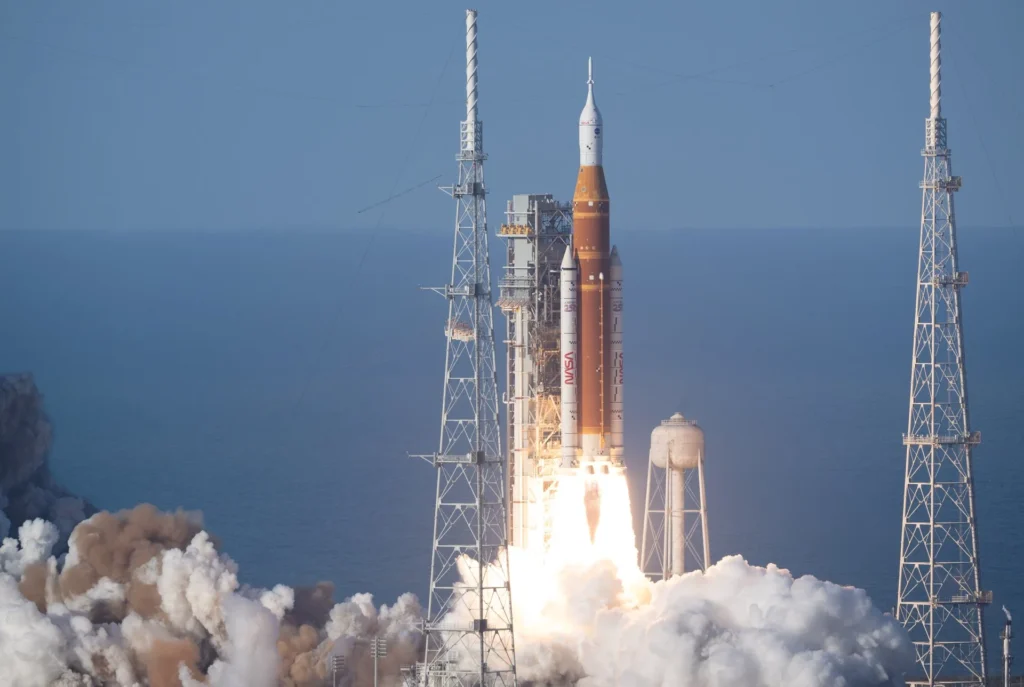
Florida NASA — At exactly 6:25 p.m. EDT (3:25 p.m. PDT) on April 1, history thundered back to life at Launch Complex 39B inside NASA’s Kennedy Space Center in Florida, as the long-anticipated Artemis II mission roared skyward in a blaze of fire and sound. Against a twilight sky, the colossal rocket pierced the air, carrying four astronauts on a bold ten-day expedition that will loop around the Moon and return them safely to Earth humanity’s first crewed voyage beyond Low Earth Orbit in more than half a century.
Inside the Orion spacecraft, a team of seasoned explorers embarked on the journey, commander Reid Wiseman, pilot Victor Glover, mission specialist Christina Koch, and Canadian Space Agency astronaut Jeremy Hansen. Together, they represent not only American leadership in deep-space exploration but also international partnership, as the Artemis program signals a new era of global cooperation beyond Earth.
Artemis II marks a pivotal milestone: the first time astronauts will travel beyond the protective cradle of Low Earth Orbit since the Apollo era. The mission is widely described as a “dress rehearsal” for future lunar landings, laying the operational and technical groundwork for returning humans to the Moon’s surface. While this flight will not land on the lunar terrain, it will push Orion and its crew farther into deep space than any modern human mission has ventured.
READ MORE:
- Artemis II | NASA, Voyage, Mission & Moon
- NASA’s Artemis II Departs Earth Orbit for Historic Moon Flyby
- NASA: The Artemis Generation Takes Flight with Historic Artemis II Mission
The mission follows the triumph of Artemis I, which successfully sent an uncrewed Orion capsule on a circumlunar voyage to validate critical systems. That earlier test flight rigorously examined the integrated performance of the Space Launch System rocket, the Orion spacecraft, and the European-built service module essential components designed to sustain astronauts on deep-space missions. Artemis II now takes the next step: placing humans aboard the spacecraft to verify how these systems function under real operational conditions.
Unlike its predecessor, this mission places astronauts in active control at key points during the journey. The crew will periodically assume manual command of Orion, testing navigation, handling, and onboard systems to ensure the spacecraft performs precisely as engineered. These exercises are vital to confirming that Orion can safely transport astronauts to lunar orbit and, eventually, to the Moon’s surface in subsequent missions.
The launch sequence unfolded with breathtaking precision. The twin solid rocket boosters ignited first, unleashing immense power and providing more than 75 percent of the thrust needed to propel the rocket off the pad and through the lower atmosphere during the first two minutes of ascent. Moments later, the four RS-25 engines roared to life, sustaining full thrust as the vehicle accelerated skyward.
At 6:37 p.m. EDT (3:37 p.m. PDT), the solid rocket boosters completed their burn and cleanly separated from the core stage, peeling away as planned while the RS-25 engines continued firing. Just one minute afterward, the Launch Abort System detached from the top of the rocket a milestone indicating the spacecraft had safely cleared the densest layers of Earth’s atmosphere. With that separation, the Orion capsule, named Integrity, pressed onward atop the core stage, beginning its long arc toward the Moon.
As Artemis II speeds into the darkness of deep space, it carries more than four astronauts. It carries the ambitions of a generation determined to extend humanity’s reach once again — not just to revisit the Moon, but to establish a sustainable presence that could one day serve as a stepping stone to Mars and beyond.
As Artemis II continued its flawless ascent into the evening sky, another critical milestone was reached at precisely 6:43 p.m. EDT (3:43 p.m. PDT). The roar of the rocket’s engines fell silent as main engine cutoff was confirmed — a decisive moment signaling that the core stage had expended its propellant and completed its role in propelling the spacecraft beyond Earth’s atmosphere. Moments later, the massive core stage separated cleanly from the Interim Cryogenic Propulsion Stage (ICPS) and the Orion spacecraft, marking a textbook transition from launch to orbital operations.
With the primary booster stage discarded, the mission entered its next phase. The ICPS, a powerful upper stage designed for precision maneuvers in space, ignited its single RL10 engine to deliver the final, calculated push. That burn elevated Orion call sign Integrity — into a higher, stable orbit around Earth. The maneuver was crucial, placing the spacecraft on the proper trajectory for the next steps in its journey toward deep space and ultimately the Moon.
By 6:59 p.m. EDT (3:59 p.m. PDT), the spacecraft underwent another dramatic transformation. Four expansive Solar Array Wings unfurled from the European Service Module, their panels stretching outward like metallic petals opening to the Sun. With the arrays fully deployed, Integrity began generating its own power, transitioning from launch vehicle support to autonomous spacecraft operations. The successful deployment not only confirmed the health of the service module but also symbolized Orion’s independence as it prepared to venture far beyond Earth’s immediate orbit.
The carefully choreographed sequence of separations, burns, and deployments underscored years of engineering precision and international collaboration. Each milestone brought the mission one step closer to fulfilling its objective: validating every system necessary for safely carrying astronauts around the Moon and back.
Later that evening, at 8:00 p.m. EDT (5:00 p.m. PDT), NASA convened a post-launch press conference at Kennedy Space Center. Officials gathered before a global audience to review the launch sequence and provide updates on the spacecraft’s condition. During the briefing, Administrator Jared Isaacman commended the astronauts, engineers, and mission teams for executing what he described as a landmark achievement in human spaceflight.
He praised the crew’s composure and professionalism, as well as the thousands of personnel across the country who made the mission possible, emphasizing that Artemis II represents far more than a single launch. According to Isaacman, the flight stands as proof that a new generation of exploration is not only underway but accelerating — one that will carry humanity beyond Earth’s orbit once again and lay the groundwork for a sustained presence in deep space.
As the conference concluded, Artemis II continued its silent journey overhead — a spacecraft powered by sunlight, guided by precision engineering, and carrying with it the renewed ambition of a world ready to return to the Moon.
After a 54-year pause, NASA has officially resumed human missions to the Moon. Reaching this moment required years of steady dedication, national resolve, and the tireless contributions of thousands within the agency, alongside industry collaborators and international partners. I extend my deepest gratitude to the ground teams, launch controllers, and every member of the workforce at Kennedy Space Center. This achievement is just as much yours as it is the astronauts’.
Late in the evening, at precisely 11:37 p.m. EDT (8:11 p.m. PDT), the Artemis II crew checked off one of the mission’s first major objectives, successfully completing a complex proximity operations demonstration in orbit. Over the course of roughly 70 minutes, the astronauts skillfully maneuvered the Orion spacecraft, Integrity, through a carefully choreographed sequence of approach-and-retreat exercises. Using the now-detached Interim Cryogenic Propulsion Stage (ICPS) as a stand-in target, the crew guided the capsule closer, then backed away, repeating the controlled movements to simulate the delicate navigation required when operating near another vehicle in space.
The exercise was more than a routine test. It offered mission controllers and engineers a rare opportunity to evaluate how Orion performs under manual control during close-range flight — a scenario that demands extreme precision and situational awareness. Data gathered during the demonstration will play a critical role in validating the spacecraft’s handling characteristics and responsiveness, particularly in preparation for the intricate docking maneuvers planned for future missions.
Those future objectives loom large. In the next phase of the Artemis campaign, astronauts will rendezvous and dock in lunar orbit with a Human Landing System (HLS), the vehicle designed to ferry crews from orbit down to the Moon’s surface. Artemis III will include a full orbital rendezvous test, while Artemis IV and V are slated to expand lunar surface exploration. Mastering proximity operations now ensures that when those high-stakes dockings occur hundreds of thousands of miles from Earth, both astronauts and spacecraft will be fully prepared.
The milestone followed a productive morning for the mission team. At 9:15 a.m. EDT (6:15 a.m. PDT), NASA confirmed that Integrity had successfully executed its Perigee Raise Maneuver (PRM), a critical engine burn designed to adjust and elevate the spacecraft’s orbit. The maneuver proceeded exactly as planned, refining Orion’s trajectory and setting the stage for the next decisive step in its journey.
Soon after, mission managers announced that the spacecraft was officially “Go” for the Apogee Raise Burn (ARB) — the powerful maneuver that will propel Orion beyond Earth’s gravitational cradle and onto a translunar injection path toward the Moon. Scheduled for 7:49 p.m. EDT (4:49 p.m. PDT), the burn will ignite the main engine of the European Service Module, delivering nearly six minutes of sustained thrust — precisely five minutes and 49 seconds — to send Integrity accelerating toward deep space.
Together, the day’s carefully executed maneuvers reflect a mission steadily building momentum. Each successful test and engine firing carries Artemis II closer to its ultimate goal: proving that Orion and its crew are ready to extend humanity’s reach back to the Moon and lay the groundwork for a sustained presence in lunar orbit and beyond.
Who is commander Reid Wiseman
Gregory Reid Wiseman, born November 11, 1975, stands at the forefront of America’s renewed push toward deep space exploration. A veteran naval aviator turned astronaut, Wiseman now commands the historic 2026 Artemis II mission a landmark lunar flyby set to become the first crewed journey around the Moon since Apollo 17 closed the curtain on that era in 1972.
His leadership of Artemis II places him in rare company. More than five decades after humanity last sent astronauts beyond low Earth orbit, Wiseman assumes the mantle once held by Apollo commander Gene Cernan. At 50 years old, he also becomes the oldest individual ever to venture past Earth’s immediate orbital neighborhood, underscoring both his experience and the trust placed in him by NASA.
Wiseman’s path to this moment began in June 2009, when he was selected as part of NASA’s 20th astronaut class. Two years later, he officially earned his astronaut wings. His first journey into space came in 2014, when he launched aboard a Soyuz spacecraft as a flight engineer for Expeditions 40 and 41 to the International Space Station. During his nearly six-month stay in orbit, Wiseman contributed to a wide range of scientific research and operational activities before returning to Earth in November of that year.
Before joining NASA’s astronaut corps, Wiseman built a distinguished career in the U.S. Navy. As a naval aviator and later a test pilot, he logged extensive flight hours and honed the technical and leadership skills that would later define his NASA career. His operational expertise and steady command presence eventually earned him senior leadership roles within the agency.
In June 2017, Wiseman was appointed Deputy Chief of NASA’s Astronaut Office, serving under Chief Astronaut Patrick Forrester. His ascent continued on December 18, 2020, when he was named the 17th Chief of the Astronaut Office one of the most influential positions in American human spaceflight. In that role, he oversaw astronaut training, mission assignments, and operational readiness during a transformative period that included preparations for Artemis missions to the Moon. He stepped down from the post in November 2022, later transitioning command responsibilities as leadership evolved within the office.
On April 1, 2026, Wiseman returned to the spotlight not as an administrator, but as a mission commander. As Artemis II lifted off, he carried with him decades of experience from naval cockpits to orbital laboratories now focused on guiding humanity’s next great leap outward. His role commanding the lunar flyby symbolizes continuity between past and present: a bridge from Apollo’s final chapter to a new era of exploration aimed at sustained lunar presence and, eventually, missions to Mars.
For Wiseman, the journey represents more than personal achievement. It embodies NASA’s long-awaited return to deep space and a renewed promise that the Moon is no longer a distant memory, but the next step forward.
Long before he commanded a mission bound for the Moon, Reid Wiseman built a formidable career in the cockpit of some of the U.S. Navy’s most advanced fighter jets.
Commissioned as an officer through the Naval Reserve Officers Training Corps (NROTC) program after graduating from Rensselaer Polytechnic Institute in 1997, Wiseman began his naval journey at Naval Air Station Pensacola, Florida — the cradle of U.S. naval aviation — where he underwent rigorous flight training. By 1999, he had earned the coveted designation of Naval Aviator, a milestone that opened the door to the high-performance world of carrier-based fighter aviation.
He was subsequently assigned to Fighter Squadron 101 at Naval Air Station Oceana, Virginia, where he transitioned to flying the F-14 Tomcat, the Navy’s iconic supersonic interceptor. After completing his initial training, Wiseman joined Fighter Squadron 31, also based at NAS Oceana. There, he deployed twice to the Middle East, supporting critical combat operations including Southern Watch, Enduring Freedom, and Iraqi Freedom. These deployments placed him in demanding operational environments, sharpening his tactical skills and leadership under real-world combat conditions.
During his second deployment in 2003, Wiseman’s performance earned him selection to the prestigious U.S. Naval Test Pilot School at Naval Air Station Patuxent River, Maryland. As a member of Class 125, he underwent one of the military’s most academically and technically challenging programs, designed to train pilots to evaluate and refine cutting-edge aircraft systems. Upon graduating in June 2004, he remained at Patuxent River as a Test Pilot and Project Officer with Air Test and Evaluation Squadron Two Three (VX-23).
At VX-23, Wiseman played a key role in advancing next-generation naval aviation capabilities. He contributed to flight test programs involving the F-35C Lightning II, the carrier-based variant of the Joint Strike Fighter, as well as weapons separation testing and carrier suitability evaluations for the F/A-18 Hornet. He also worked on testing related to the T-45 Goshawk training aircraft. During this assignment, he earned a Master of Science degree, further strengthening the technical foundation that would later serve him at NASA.
After completing his tour at Patuxent River, Wiseman reported to Carrier Air Wing Seventeen (CVW-17) as Strike Operations Officer. In that capacity, he coordinated complex air operations and completed a deployment that included operations around South America. He later joined Strike Fighter Squadron 103 at NAS Oceana, flying the F/A-18F Super Hornet one of the Navy’s most versatile multirole fighters. It was during a subsequent deployment to the Middle East that he received the call that would redirect his career toward space: his selection for astronaut training.
Over the course of his naval service, Wiseman accumulated not only flight hours and operational experience, but also a distinguished record of commendations. His decorations include the Air Medal with Combat “V” awarded five times recognizing acts of heroism or meritorious achievement in combat, as well as the Navy and Marine Corps Commendation Medal with Combat “V” on four occasions. He also received the Navy and Marine Corps Achievement Medal, in addition to multiple campaign and service awards reflecting his extensive operational contributions.
From combat deployments to experimental flight testing, Wiseman’s naval career forged the discipline, precision, and resilience that would ultimately prepare him for leadership far beyond Earth’s atmosphere.
- Worst Country I’ve Visited- Thailand Girl, Stark Warning After Disappointing Vietnam Trip
- Artemis II | NASA, Voyage, Mission & Moon
- A Prayer of Thanksgiving for Divine Blessings, Triumph, Forgiveness, and Good Health
- NASA’s Artemis II Departs Earth Orbit for Historic Moon Flyby
- NASA: The Artemis Generation Takes Flight with Historic Artemis II Mission
- Victor Glover | Life, Education & NASA Career
- Philippines vs China, When Betrayal Comes from Within: The Cost of Selling a Nation
- Supreme Court Affirms Dismissal of GMA Network’s Complaint Against ABS-CBN Over TV Ratings Dispute
- List of political ideologies
- Andrew Heywood | British author, Educationalist, & political theorist
- Holy Wednesday: A Solemn Reminder on Judas Iscariot Betrayal of Jesus Christ
- Judas Iscariot | About in the Bible, Betrayal & Apostle
- Relief or Rhetoric? Imee Marcos’ Call to Suspend Government Deductions Remains Without Action—Just Words
- Gatchalian Renews Push to Keep Minors Off Social Media
- Donald Trump Floats Seizing Iran’s Kharg Island Oil Hub, Wider Middle East Conflict
https://www.nasa.gov/history/glenn-orbits-the-earth/https://www.nasa.gov/missions/oct-29-1998-john-glenn-returns-to-space/https://www.nasa.gov/centers-and-facilities/glenn/from-sky-gazing-to-astronaut-janet-kavandi-reaches-the-astronaut-hall-of-fame/https://www.nasa.gov/technology/in-nasa-glenns-virtual-reality-lab-creative-minded-employees-thrive/https://www.nasa.gov/history/naca-test-pilot-competed-in-cleveland-national-air-races/https://www.nasa.gov/centers-and-facilities/glenn/watch-nasa-glenn-intern-stories-on-2019-national-intern-day/https://www.nasa.gov/centers-and-facilities/glenn/a-need-for-speed-life-as-a-champion-racecar-driver-and-nasa-propulsion-facility-manager/https://www.nasa.gov/people-of-nasa/nasas-chas-hoff-connects-with-his-native-american-roots/https://www.nasa.gov/people-of-nasa/nasas-jeremiah-ocallahan-values-native-american-roots-and-community-outreach/https://www.nasa.gov/aeronautics/looking-back-at-how-nasa-looked-ahead-during-2013/https://www.nasa.gov/centers-and-facilities/armstrong/nasas-10-favorite-ways-to-celebrate-national-aviation-day/https://www.nasa.gov/centers-and-facilities/armstrong/3d-printing-offers-multi-dimensional-benefits-to-aviation/https://www.nasa.gov/aeronautics/nasa-book-reveals-fascination-with-wing-twist/https://www.nasa.gov/centers-and-facilities/langley/a-sign-from-nasas-past-goes-to-national-air-and-space-museum/https://www.nasa.gov/centers-and-facilities/armstrong/access-ii-confirms-jet-biofuel-burns-cleaner/https://www.nasa.gov/centers-and-facilities/armstrong/access-ii-alternative-jet-fuel-flight-tests-begin/https://www.nasa.gov/aeronautics/seeking-reality-in-the-future-of-aeronautical-simulation/https://www.nasa.gov/centers-and-facilities/armstrong/nasa-aeronautics-contributes-to-orions-atmospheric-flight-capability/https://www.nasa.gov/centers-and-facilities/ames/nasa-aces-delicate-operation-with-aircraft-tail/https://www.nasa.gov/aeronautics/airplanes-or-langleys-and-other-tales-of-the-naca/https://www.nasa.gov/aeronautics/apollo-11s-return-to-earth-rooted-in-aeronautics-research/https://www.nasa.gov/centers-and-facilities/langley/aspiring-young-researchers-help-nasa-solve-aviation-challenges/https://www.nasa.gov/centers-and-facilities/langley/nasa-researchers-to-flying-insects-bug-off/https://www.nasa.gov/centers-and-facilities/langley/full-scale-tunnel-story-told-in-new-nasa-book/https://www.nasa.gov/centers-and-facilities/ames/nasa-centers-team-up-to-tackle-sonic-boom/https://www.nasa.gov/centers-and-facilities/langley/teamwork-makes-chopper-drop-a-success/https://www.nasa.gov/centers-and-facilities/langley/cockpit-software-could-help-pilots-plot-best-path/https://www.nasa.gov/aeronautics/federal-agencies-come-together-to-highlight-uas-capabilities/https://www.nasa.gov/aeronautics/five-new-ideas-to-be-explored-by-nasa-aeronautics-teams/https://www.nasa.gov/aeronautics/nasa-administrator-talks-green-aviation-with-global-airline-audience/https://www.nasa.gov/centers-and-facilities/langley/nasa-goes-down-under-to-tap-high-altitude-ice/https://www.nasa.gov/centers-and-facilities/langley/nasa-to-crash-test-helicopter-to-study-safety/https://www.nasa.gov/centers-and-facilities/ames/holiday-season-makes-most-of-nasa-aeronautics-gifts/https://www.nasa.gov/aeronautics/ikos-debugger-zaps-error-rate-for-aviation-software-developers/https://www.nasa.gov/aeronautics/industry-provides-nasa-with-ideas-for-next-x-plane/https://www.nasa.gov/aeronautics/industry-weighs-in-on-green-aviation-tech/https://www.nasa.gov/aeronautics/nasa-lego-contest-names-winning-designs/https://www.nasa.gov/aeronautics/longtime-nasa-aeronautical-innovator-doug-rohn-retires/https://www.nasa.gov/centers-and-facilities/armstrong/nasa-aero-teams-to-study-if-wild-ideas-are-possible/https://www.nasa.gov/aeronautics/nasas-aeronautics-associate-administrator-honored-for-innovation/https://www.nasa.gov/aeronautics/nasa-aeronautics-ambitious-ideas-showcased/https://www.nasa.gov/aeronautics/nasa-aeronautics-selects-three-university-teams-for-research-help/https://www.nasa.gov/aeronautics/nasa-air-traffic-management-demonstration-goes-live-in-charlotte/https://www.nasa.gov/aeronautics/nasa-air-traffic-management-research-tool-shows-new-colors/https://www.nasa.gov/aeronautics/nasa-aircraft-arrival-technology-gets-big-test-in-2017/https://www.nasa.gov/centers-and-facilities/ames/nasa-army-celebrate-50-years-of-rotorcraft-collaboration/https://www.nasa.gov/aeronautics/nasa-celebrates-air-and-space-at-eaa-airventure-2016/https://www.nasa.gov/centers-and-facilities/langley/nasas-common-research-model-finds-common-ground-worldwide/https://www.nasa.gov/centers-and-facilities/armstrong/nasa-completes-high-ice-water-content-radar-flight-campaign-in-florida/https://www.nasa.gov/centers-and-facilities/ames/nasa-completes-its-latest-drone-traffic-management-flight-campaign/https://www.nasa.gov/aeronautics/nasa-contracts-to-demonstrate-unmanned-aircraft-technologies/https://www.nasa.gov/aeronautics/nasa-debuts-initiative-where-universities-take-the-lead/https://www.nasa.gov/aeronautics/nasa-delivers-new-air-traffic-spacing-tool-to-faa/https://www.nasa.gov/centers-and-facilities/ames/nasa-drone-traffic-management-tests-take-off-in-reno/https://www.nasa.gov/centers-and-facilities/ames/nasa-embraces-urban-air-mobility-calls-for-market-study/https://www.nasa.gov/aeronautics/nasa-engages-innovation-faithful-at-oshkosh/https://www.nasa.gov/aeronautics/nasas-experimental-supersonic-aircraft-now-known-as-x-59-quesst/https://www.nasa.gov/aeronautics/nasa-funds-five-teams-to-study-inventive-ideas-for-aviation/https://www.nasa.gov/centers-and-facilities/armstrong/nasa-takes-next-step-in-green-aviation-x-planes-plans/https://www.nasa.gov/aeronautics/nasa-helps-educators-connect-with-new-imax-airplanes-film/https://www.nasa.gov/centers-and-facilities/armstrong/nasa-instruments-head-to-germany-for-alternative-fuels-research/https://www.nasa.gov/aeronautics/nasa-issues-a-challenge-to-speed-up-its-supercomputer